


Peplink 5G nachrüsten: Warum moderne 5G-Modems vier Antennenpfade brauchen
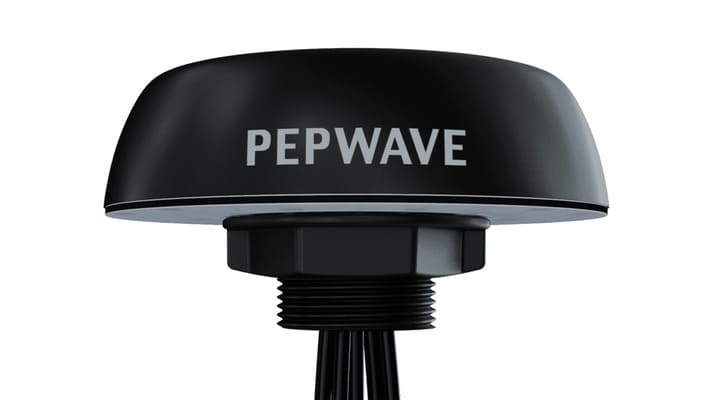
A proven setup in many companies: a Peplink B One bonds the fixed-line connection with a cellular router as a second WAN. When switching from LTE to 5G, a surprise often follows — the existing 2×2 MIMO antenna with its two connectors no longer matches the new 5G device, because modern 5G modems require four antenna paths. Why that is, which Peplink options exist and what you should watch out for when planning — read it here.
Why four antenna paths? A look at the 3GPP standard
The most important 5G capacity band in Germany is n78 (3.3–3.8 GHz) — this is where the network operators deliver the high data rates that make the move to 5G worthwhile. For precisely this band, the mobile standard stipulates a minimum configuration: the 3GPP specification TS 38.306 requires at least four receive antennas for devices in bands n77/n78/n79 (and a few others).
Behind this is 4×4 MIMO: four spatially separated antenna paths transmit multiple data streams in parallel. Compared with 2×2 MIMO, this not only doubles the possible downlink throughput but also improves connection stability — with only two antennas connected, throughput is roughly halved, and the connection reacts far more sensitively to shading of individual antenna elements. The four-antenna requirement is therefore not a vendor quirk, but a standard requirement.
The generational change in Peplink's 5G modems
All Peplink 5G devices have four antenna connectors (A/B/C/D). Whether operation with only two connected antennas is possible depends on the modem generation:
- Older generation ("5GH", Qualcomm X55): These devices offered an official "2× Antenna Mode" (connectors A and D) from firmware 8.3.0. The compromise was clear: LTE drops from Cat 20 to Cat 16, individual bands are lost, and especially on n78 Peplink documents a noticeably lower connection stability. This product generation has since been discontinued and is no longer regularly available.
- Current generation ("5GN", Qualcomm X62): Here Peplink's position is unambiguous: all four antenna paths must be populated. A 2-antenna mode no longer exists; anyone populating only two connectors loses, among other things, the n78 band entirely — precisely the band for which one upgrades to 5G.
- Newest generation ("5GK", Qualcomm X65): There are no official statements on 2-antenna operation. For planning purposes, the general rule therefore applies: budget for four antenna paths.
The practical consequence: an existing 2×2 antenna can no longer be operated alone on current Peplink 5G hardware. You need four paths — either via one 4×4 antenna or via two identical 2×2 antennas, because Peplink recommends antennas of the same type and performance on all four connectors.
Your options at the Peplink B One
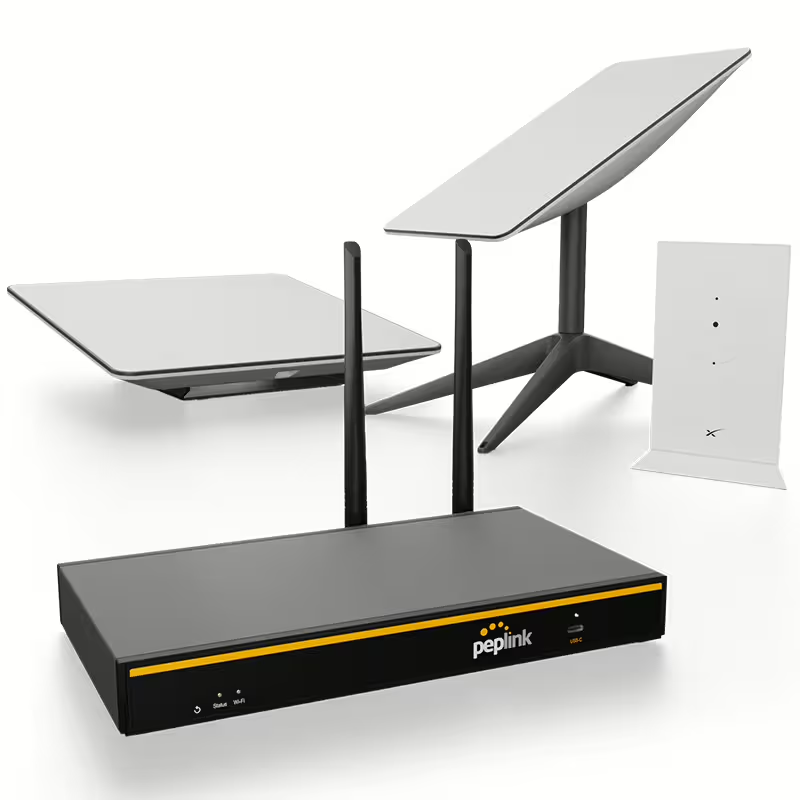
The Peplink B One offers two gigabit WAN ports, Wi-Fi WAN and a USB-C WAN port — it has no cellular modem of its own. For 5G as a second WAN, there are three available routes:
1. The 5G adapter as an external modem: The Peplink 5G Adapter (ADP-5GZ-T-PRM) is connected via 2.5-gigabit Ethernet to a WAN port of the B One. Important for planning: it is powered via 802.3at PoE or its own power supply — the B One does not provide PoE, so a PoE injector belongs on the bill of materials. For the four antenna paths, a compact 4×4 omni-directional antenna such as the Poynting XPOL-1-5G (A-XPOL-0001-V2-41) is a good fit: a single antenna with four SMA connectors, 617–3800 MHz (n78 included), mountable on windows, walls or masts.
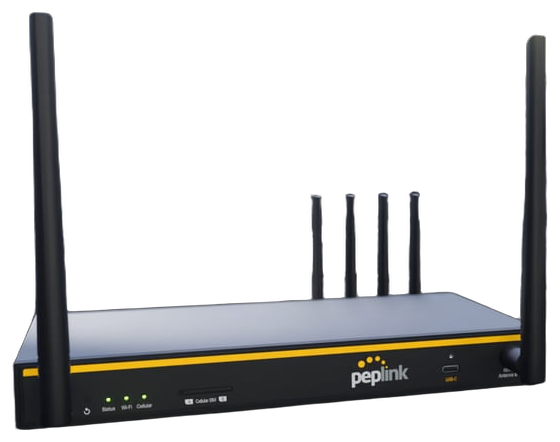
2. Everything in one device — the B One 5G: The Peplink B One 5G integrates the 5G modem directly into the router and comes with two SIM slots. Anyone considering an upgrade anyway replaces router and separate cellular router in one step — again with four antenna connectors for full 5G operation.
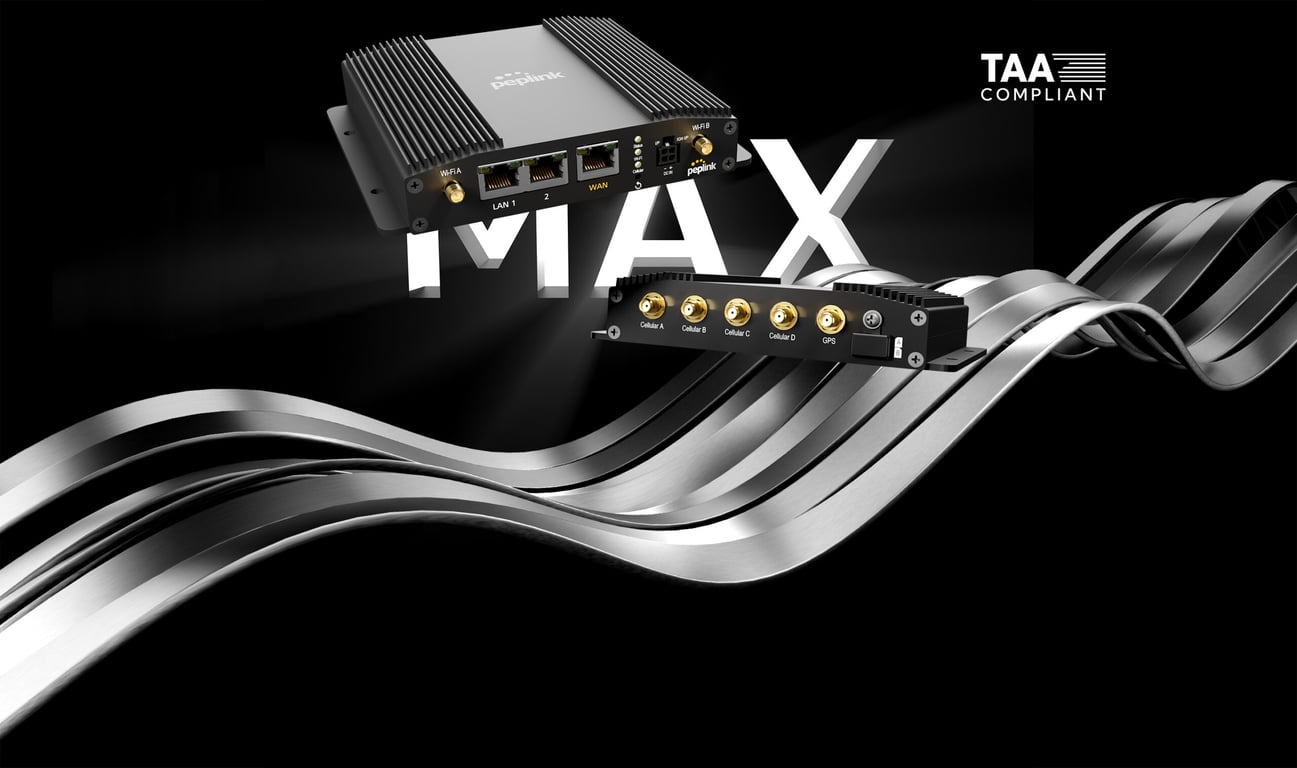
3. A standalone 5G router as a feeder: For more demanding installations, the Peplink MAX BR1 Pro 5G delivers the latest 5G modem generation ("5GK"); more compact and more affordable, the Peplink MAX BR1 Mini 5G takes on this role — it is also the device Peplink positions as the successor to the discontinued MAX Adapter 5G. Both feed the B One via Ethernet as a second WAN.
Checklist for planning
- Antenna paths: Plan for four paths — one 4×4 antenna or two identical 2×2 antennas. A single 2×2 antenna is no longer sufficient on current 5G hardware.
- Frequency bands: For the Telekom network, LTE B1/B3/B7/B8/B20/B28/B32 as well as 5G n1/n3/n28/n78 should be covered — both by the device (note the regional SKU variant) and by the antenna.
- Power supply: Ethernet-based adapters require PoE or their own power supply; this belongs on the bill of materials too.
- Firmware: Keep the B One up to date — USB-WAN requires at least firmware 8.1.1, IP passthrough is available from firmware 8.5.0.
- Compare reception values: Measure RSRP, RSRQ and SINR before and after the conversion — this allows the gain from 5G and the new antenna configuration to be cleanly documented.
Conclusion
The four-antenna requirement of modern 5G modems is anchored in the standard and cannot be configured away — anyone who factors it in early when migrating from LTE to 5G avoids bad purchases and follow-up orders. All the devices and antennas presented are available from us. Unsure which variant suits your site and reception conditions? Our team will be happy to advise you on selection, band coverage and antenna planning.
Matching Products
Matching hardware straight from the ASCEND shop — availability and prices are shown on the product detail page.

Request a consultation
Do you have questions about this solution or want to take your network to a professional level? Our certified engineers will be happy to advise you — from initial analysis all the way to production rollout.
Frequently Asked Questions
Related Links
This article was researched and written with AI assistance and reviewed prior to publication by Ascend's certified engineers.
Products mentioned in this article
Ready for your next project?
Talk to our team about your requirements.
Related posts

WLAN für Baustellen und Veranstaltungen einfach mieten
Verzögert sich die Lieferung der Internetanbindung oder benötigen Sie nur kurzfristig WLAN für Events oder Baustellen WLAN? Dann einfach WLAN Hotspot mieten von Ascend . _“Auf Dauer ist ein Handy-Hotsp…
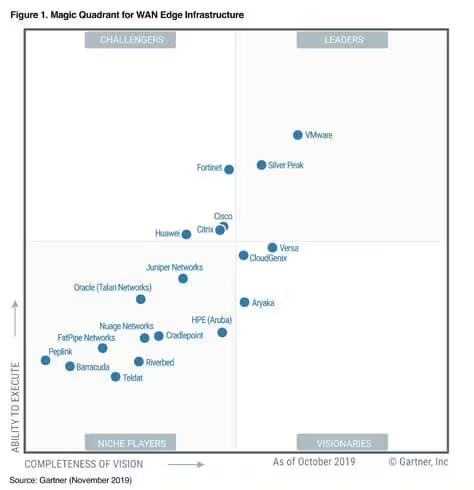
Wie hilft einem der SD WAN Gartner „Magic Quadrant” bei der Auswahl des SD-WAN Anbieters?
Gartner „Magic Quadrant“
Verbessern Sie Ihr WLAN zuhause mit dem Peplink B One Router
In der heutigen Zeit ist ein zuverlässiges WLAN zuhause unverzichtbar. Der Peplink B One Router stellt eine beeindruckende Lösung dar, die nicht nur das WLAN-Signal verstärkt, sondern auch die Sicherheit Ihres Net…