









Virtual SpeedFusion appliance
Peplink FusionHub: the virtual SpeedFusion hub that holds your tunnels
A Peplink router only bonds DSL, cellular and Starlink into a single line if a hub at the other end puts the packets back together. FusionHub is that hub as software: a virtual machine in your data center or in the cloud, licensed in tiers from Essential (5 peers) to FusionHub 4000. Ascend supplies the license, sets up the instance and looks after it around the clock.
The principle at a glance
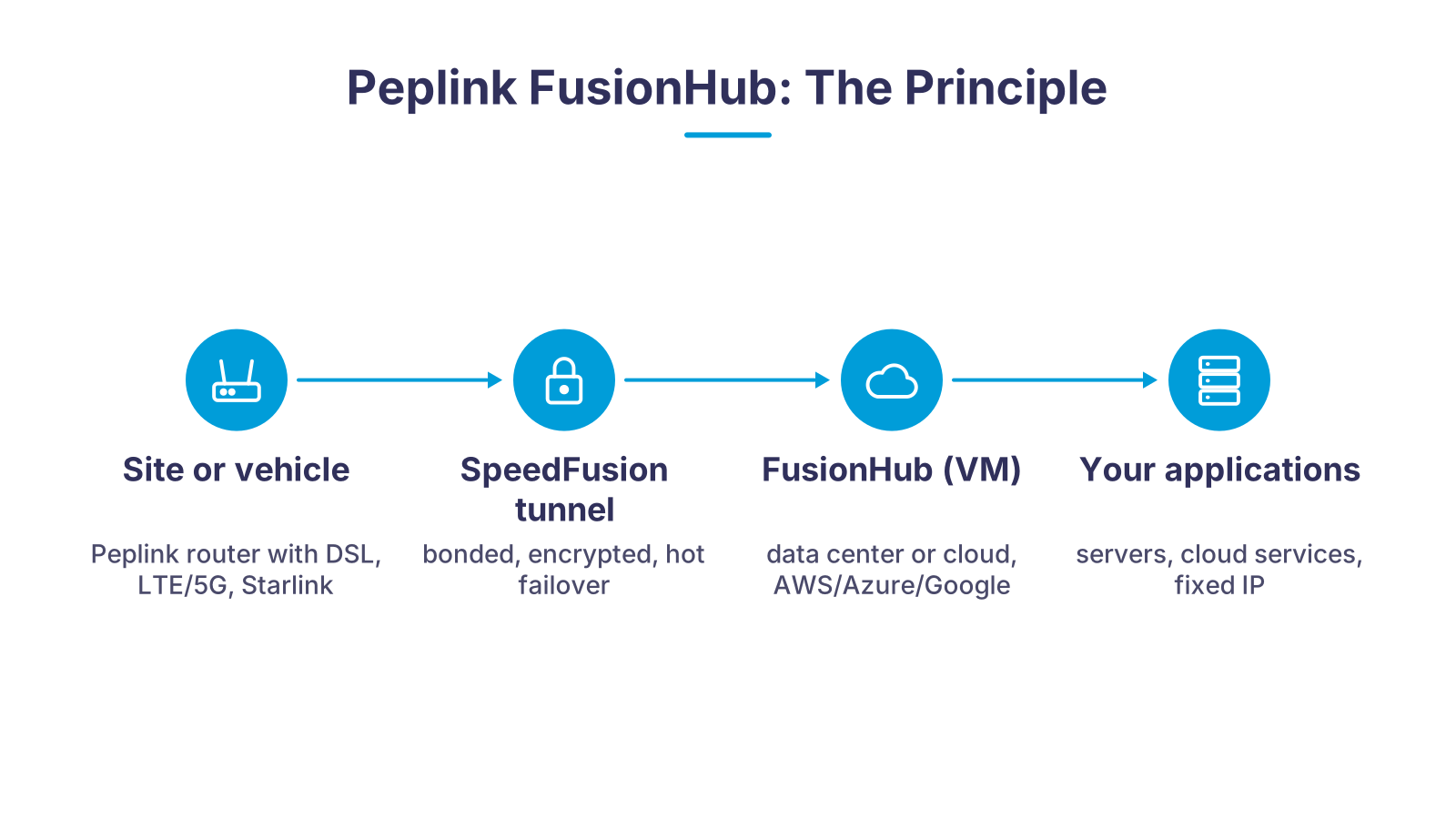
The Peplink router at the site or in the vehicle splits the data stream across all available lines and sends it through an encrypted SpeedFusion tunnel. FusionHub receives the packets as a virtual machine in the data center or in the cloud, reassembles them in the correct order and passes them on as a single connection to your servers, cloud services or the internet. If one line fails, the session carries on over the remaining ones.
What FusionHub does for you
A bonding router without a counterpart can only switch between lines. FusionHub is what turns that into bonding, uninterrupted failover and a fixed address for your sites.
Add up bandwidth
Keep sessions alive
No hardware in the data center
Connect cloud servers
Manage centrally
Managed by Ascend
FusionHub license tiers compared
| SpeedFusion peers | Typical use | AWS instance recommended by Peplink | |
|---|---|---|---|
| FusionHub Essential | 5 peers (per shop) | One vehicle, one outside-broadcast van or up to five small sites; the entry point for your own hub. | t2.micro for 5 peers and 100 Mbps |
| FusionHub Pro | 20 peers (per shop) | Several branches, home-office connections and mobile teams. | t2.small for 20 peers and 200 Mbps |
| FusionHub 100 | Tier 100 (Peplink's AWS recommendation lists 100 peers) | Networks with many branches or vehicles. | t2.small for 100 peers and 200 Mbps |
| FusionHub 500 | 500 peers (per Peplink manual) | Large branch or vehicle networks. | m4.large for 500 peers and 500 Mbps |
| FusionHub 1000 | 1000 peers (per shop) | Very large networks with up to a thousand endpoints. | c4.2xlarge for 1000 peers and 1 Gbps |
| FusionHub 2000 and 4000 | The largest tiers; we will give you the peer count on request. | Very large networks; we size the instance together with you. | No recommendation from Peplink; sizing with Ascend |
| MSP Edition | Client licenses in packs of 1, 10, 50, 100, 500 and 1000 | Members of the SpeedFusion Alliance who run a separate instance per customer. | Per instance according to the values above; the larger the pack, the lower the price per client. |
VM host and cloud instance: what FusionHub needs
| Hypervisors | VMware ESXi (5.5 or later), VMware Workstation and Player, Oracle VirtualBox, Citrix XenServer, Microsoft Hyper-V (generation 1). |
|---|---|
| Public clouds | Amazon Web Services, Microsoft Azure, Google Cloud, Vultr. |
| Minimum VM host specification | Intel Core i5, 4 GB RAM, 100 GB hard disk (does not apply to AWS instances). |
| Recommendation for 1 Gbps SpeedFusion throughput | Xeon E3-1270 v2 at 3.5 GHz, 8 GB RAM, 500 GB hard disk. |
| Minimum VM memory | 1024 MB on Hyper-V and VirtualBox; network adapter VMXNET 3 (ESXi) or E1000 (XenServer). |
| VPN protocols | SpeedFusion, IPsec, GRE, OpenVPN, L2TP with IPsec. |
| Routing and security | OSPF, RIPv2, BGP; stateful firewall with access rules, content blocking, RADIUS authentication. |
| Management | Web interface with setup wizard, InControl 2, SNMP, e-mail notification, event log. |
| License | One-time, tiered by peers; activation and transfer via InControl 2. InControl access, firmware updates and Peplink support via EssentialCare (1, 2 or 4 years). |
| Trial | Free 30-day trial on your own hardware. |
Why the hub is half of bonding
Many inquiries start with a router: a MAX HD4 for the broadcast van, a MAX Transit for the bus, a Balance for the branch. The second half is often forgotten. SpeedFusion is a tunnel, and a tunnel has two ends. The router distributes the packets across DSL, LTE, 5G or Starlink; somewhere, someone has to put them back in the right order, make up for gaps and pass the data stream on as a single connection. That is the job of FusionHub.
Without this counterpart, all that is left of SpeedFusion is switching between lines. With it, you get the real features: bandwidth bonding, hot failover at packet level, WAN Smoothing against jitter and packet loss, and a fixed public address behind which all sites can be reached. A video conference keeps running when the DSL line drops; a livestream from the vehicle holds while the cellular network changes.
FusionHub is deliberately not hardware. The virtual appliance runs on the hypervisor you already operate, or as an instance in a public cloud. That puts the hub where your data needs to go: next to the ERP system in the data center, next to the cloud servers at AWS or Azure, or at Ascend if you would rather not run a hub of your own at all.
Run it or rent it: three ways to the counterpart
Your own data center. You have VMware, Hyper-V or XenServer in-house and want control over the counterpart. We then install FusionHub as a VM on your host, connect it to your firewall and attach the routers. Your site data never leaves your infrastructure.
Public cloud. Your applications already run at AWS, Azure, Google Cloud or Vultr. In that case FusionHub belongs right next to them: the sites reach the cloud servers through the bonded tunnel, without a detour via the corporate network. Which instance size you need depends on peers and throughput; the license table above lists Peplink's AWS recommendations.
Hosted by Ascend. You do not want to maintain a hypervisor or buy a license. On our hosted VPN hub the SpeedFusion counterpart runs as a managed service in a data center in Germany, either as a shared hub per tunnel or as a dedicated hub with a static IPv4 address. The FusionHub license is then included in our price.
In all three cases the technology stays the same. The router configures itself for the hub via InControl 2, and you can switch later: a purchased license can be released in InControl 2 and imported into a new instance, for example when moving from your own host to the cloud.
For enterprises and for managed service providers
Enterprises use FusionHub as a concentrator for branches, home offices and vehicles. Each site brings two or three inexpensive lines, and the hub turns them into one connection with a fixed address to the data center. This replaces costly leased lines and MPLS connections, and it lets you use cloud resources on the move without interruption. With InControl 2 you can see per site which applications and domains consume data, as a table, pie chart or connection graph.
Managed service providers run several FusionHub instances in their data center and give each customer a dedicated SpeedFusion-capable hub. The MSP Edition is billed not by tier but by client licenses: packs of 1, 10, 50, 100, 500 or 1000 peers grow with your customer base. Membership in the SpeedFusion Alliance is a prerequisite. That turns your own infrastructure into a product: faster internet at poorly connected locations, highly available site-to-site VPN over standard internet connections, bonding as a service.
What Ascend takes on in both cases: we have been on the market since 2010 and are a Peplink partner. We size the license tier based on your sites and throughput targets, install the instance on your hypervisor or in your cloud, configure tunnels, routing and firewall, attach the routers and, on request, supply the multi-network SIM too. Our support is available 24x7. If you want to master the technology yourself, you can learn it in our Peplink training on SpeedFusion and InControl 2.
From license to running hub
- 1Clarify sites and goalsWe record the number of peers, lines per site, the throughput you want and whether services need to be reachable from outside.
- 2Choose license tier and hub locationFrom Essential to FusionHub 4000 or MSP Edition; your own data center, public cloud or hosted by Ascend.
- 3Install the instanceOur technicians deploy the FusionHub image on VMware, Hyper-V, XenServer, VirtualBox or in AWS, Azure, Google Cloud and Vultr and activate the license via InControl 2.
- 4Connect the routersSpeedFusion profiles, encryption, WAN Smoothing and routing are rolled out centrally; the routers connect to the hub automatically.
- 5Test and hand overWe check failover and bonding under load, document the configuration and look after operation around the clock.
Two pitfalls before installation
If the virtual machine does not start, CPU virtualization is missing in most cases: enable "Intel VT" or, on AMD processors, "AMD-V" in the host BIOS before the operating system boots. And plan Layer 2 connections carefully: according to Peplink, FusionHub supports Layer 2 SpeedFusion from firmware 8.0. Tell us before ordering whether you need Layer 2, and we will check firmware and license.
Matching products in the Ascend shop
We deliver all FusionHub licenses and the EssentialCare packages as download licenses; activation runs via InControl 2. You can see current prices and availability directly in the shop.

Peplink FusionHub Essential
5 SpeedFusion peers, the entry point for a vehicle or a small group of sites.

Peplink FusionHub Pro
20 SpeedFusion peers for several branches and mobile teams.
- Peplink FusionHub 100
Peplink FusionHub 100
The tier between Pro and 500, for networks with many branches or vehicles.

Peplink FusionHub 500
500 peers with the full VPN and routing feature set: SpeedFusion, IPsec, GRE, OpenVPN, OSPF, BGP.

Peplink FusionHub 1000
1000 SpeedFusion peers for very large networks.

EssentialCare for FusionHub Essential (1 year)
InControl cloud management, firmware updates and Peplink support for one year.
What MDR says
Combining the Peplink devices and the bonded bandwidth with the transmission systems we already have gives us the maximum level of resilience when sending live footage.
Frequently asked questions about Peplink FusionHub
Further links
- VPN hub hosting: the counterpart as a managed service
- Peplink MAX HD4: four cellular modems for vehicles and broadcast vans
- Peplink MAX Transit: built for transport
- Site networking with Ascend
- Peplink training: SpeedFusion and InControl 2 in practice
- Peplink solutions at Ascend
- All Peplink products in the Ascend shop
- FusionHub MSP Edition: client license in the Ascend shop
Ready for a counterpart that holds your tunnels?
Send us your router models, the number of sites or vehicles and where the hub should run: your own data center, the cloud or at Ascend. We will recommend the license tier and give you the price.
We look forward to hearing from you!
Tell us your router models, the number of peers and your virtualization environment. We will get back to you shortly with a personal consultation.