





Router, Bonding, Data Plan: The Three Building Blocks of a Resilient Connection

Introduction
A resilient internet connection for a site doesn't come from a single device, and not from a single tariff either — it comes from the interplay of three building blocks that are often looked at separately in practice: the router, the bonding method, and the data plan. A router with no second path is a single point of failure, however capable it otherwise is. Two paths without bonding are, at best, a switch between two lines, with a brief interruption. And two SIM cards on the same mobile network aren't two paths at all if that network goes down — just two bills.
In this article, we look at each of the three building blocks individually and show how they work together. Ascend supplies Teltonika routers, works in partnership with Bondix Intelligence, and provides data plans for mobile use — and puts together the right combination on a project basis, matched to the sites that actually need to be secured. You'll find background on the Bondix partnership and the technical foundations on our page Teltonika Bonding, and the complete router range on the Teltonika brand page.
Why do the three building blocks need to be thought through separately, but procured together?
The three building blocks solve different problems, and none of them is enough on its own.
- A router with no second WAN input is always a single point of failure — if the one line fails, the site fails, regardless of how robust the housing is or how extensive the firmware.
- Two paths without bonding only improve the situation to a limited extent: a router with failover switches to the second line if the primary one fails. That works, but it costs a brief interruption, and running sessions generally end in the process.
- Two SIM cards on the same network are, as soon as the network operator itself has a problem – a cell, an exchange, maintenance work – no longer two paths at all, but two identical points of failure.
That's why router, bonding and data plan need to be thought of as one system from the outset, even though they're technically and commercially separate building blocks from different suppliers: Teltonika for the hardware, Bondix Intelligence as the bonding partner, the mobile operator for the data plan. Anyone who swaps out just one building block – buying a more capable router, say, without checking the network diversity of the SIM cards – keeps the original weak point.
Building block 1 — router: what requirements must the hardware meet?
The router is the platform on which the other two building blocks can even work. For a resilient connection, it should bring at least four properties:
- Multiple WAN inputs — at least two SIM slots (dual-SIM) or a combination of mobile, Ethernet WAN and Wi-Fi-as-WAN, so that more than one path is even available.
- Enough processing power and throughput to run bonding on top of ordinary routing without becoming a bottleneck itself.
- Remote manageability, so configuration, status and firmware version can be monitored even at remote or changing sites. We cover how a VPN of your own and Teltonika RMS differ for this purpose in Teltonika RMS or your own VPN?.
- The right mounting form for the site: DIN rail in a cabinet, surface mounting in a vehicle, or a rugged housing at a temporary location.
With the RUTX and RUTM series, plus more compact models like the RUT951 or RUT956, Teltonika covers a broad range of these requirements. We describe in detail which models are specifically intended for bonding with Bondix in WAN bonding becomes a router app. You'll find the complete range on the Teltonika routers page.
Building block 2 — bonding: what does it deliver, and what does it need in addition to the router?
Bonding is fundamentally different from failover and load balancing: with genuine bonding, a single session uses all available lines at the same time, instead of just switching between them or distributing them session by session. We've set the three approaches side by side in Multi-WAN bonding explained. That's also why Bondix describes its own solution using the capabilities Connection Aggregation and Session-Persistent Failover: connections are bonded together, and running sessions survive the failure of a single line.
Important for procurement: bonding needs a client on the router — on Teltonika devices, since its inclusion in the RutOS Package Manager with RutOS 07.24, that's the Bondix application, which Bondix says is the first independent third-party application ever in that third-party section — plus a counterpart, where the bonded paths are brought back together. Without that counterpart, the router bonds locally but has no one to bond with. We explain how this installation works in detail, and which models are supported, in WAN bonding becomes a router app.
Ascend works in partnership with Bondix Intelligence and delivers bonding projects from a single source accordingly. One point belongs in a fair account of this: Teltonika explicitly notes in its own wiki that the Bondix package was not developed by Teltonika, and that Teltonika is not responsible for its compatibility, interoperability, security or general stability. Anyone procuring bonding should know this support boundary – and that's exactly why you need a supplier who knows both sides.
Building block 3 — data plan: why network diversity is the real lever
The third building block is the one most often underestimated in practice – yet it's the real lever for resilience. A router with two SIM slots and an operated bonding counterpart don't count for much if both SIM cards sit on the same mobile network: if a cell, an exchange, or the operator's network itself fails, both cards are affected at the same time – so the router bonds two paths that are both dead at that moment.
Bondix makes this visible in its own festival case study: the Teltonika RUTX11 with Bondix deployed there deliberately used two LTE SIM cards from different network operators to supply 50 point-of-sale systems simultaneously. The result, according to Bondix: a transaction success rate of 99.99% — explicitly a metric for successfully completed payment transactions in that project, not a general availability promise. But it demonstrates the principle: network diversity, not just the number of cards, is what actually turns two SIM cards into two independent paths.
For tariff planning, that means two things. First: when choosing cards, look for different network operators, not just two separate contracts. Second, and this is regularly overlooked: because bonding uses both paths at the same time, data volume flows on both cards simultaneously – not only once one of them fails. Anyone budgeting one card as an "emergency spare" underestimates ongoing consumption; if you're bonding, you should size both tariffs for full throughput.
Ascend supplies the matching data plans for mobile use; you'll find an overview of our data volume offer for life on the road on the page Unlimited data volume on the move, and on routers with SIM card support on Router for SIM cards. We deliberately don't publish specific prices for tariffs or for the bonding counterpart – sizing depends too heavily on the individual case, more on that below.
The fourth, often forgotten question: who operates the counterpart?
Router, bonding client and data plan are the three visible building blocks — the fourth question regularly gets forgotten in planning, because it doesn't appear on any product page: who operates the bonding counterpart? Bonding bonds paths by having both sides — the router at the site and a counterpart on the network — establish the same connection and bring the data streams back together there. Someone has to operate this counterpart: monitor it, keep it current, be reachable if something goes wrong.
Anyone who doesn't want to, or can't, take on this role in their own data centre or cloud environment needs an operator for exactly this part of the infrastructure. With VPN Hub Hosting, Ascend operates counterparts for customers who'd rather not take this task on themselves – whether your specific bonding set-up is a fit for that, we clarify in an advisory conversation – more on that at VPN Hub. We cover in detail how a self-operated counterpart differs from a managed solution like Teltonika RMS VPN in Teltonika RMS or your own VPN? – the same operator question comes up there for remote management in general.
Example combinations by use case
How the three building blocks are put together in any given case depends heavily on the use case. Four patterns that come up often in practice — as a description, not a price list:
- Till or branch: compact router with dual-SIM, bonding for uninterrupted card payments, two data plans from different network operators. This is exactly the pattern behind the Bondix festival study, there with a RUTX11 for 50 point-of-sale systems.
- Temporary set-up: pop-up locations, trade fairs, events — here, fast commissioning matters most. For a pop-up deployment with a RUT360, Bondix reports set-up time per site falling from 2 hours to 20 minutes.
- Site without a fixed line: construction sites, rural branches, or interim solutions where no fixed-line connection exists, or laying one isn't worthwhile. Here, two mobile paths take over entirely what would otherwise be a fixed line plus a backup.
- Vehicle: mobile response vehicles, outside broadcast vans, site vehicles that need a resilient connection while moving or stationary. Mounting form and power draw play a bigger role here than at a fixed site — more on that in our article Internet in your RV: Starlink, a 5G router — or both?.
Which combination of router model, bonding configuration and data plan fits your case, we clarify in an initial conversation — based on the actual requirements on site.
Conclusion: checklist for the initial conversation
A resilient connection is created when router, bonding and data plan are planned as one system — not as three separate purchases that happen to complement each other. The router has to provide multiple paths and be remotely manageable, bonding needs a client on the router plus an operated counterpart, and the data plan, through the network diversity of the SIM cards, decides whether two paths actually become two independent paths when it matters.
To size a combination for you, the following details are helpful for an initial conversation:
- Sites: How many, where, and how different are the conditions at each?
- Available paths: Which types of connection are fundamentally available on site — mobile, fixed line, Wi-Fi?
- Bandwidth needs: How much throughput is actually required, both continuously and at peak?
- Failure tolerance: How long can an interruption last at most before it becomes business-critical?
- Mounting environment: Cabinet, vehicle, outdoor, temporary set-up — this determines form factor and housing.
- Remote maintenance requirement: Who needs to see device status, and how often?
We put together the combination of router, bonding and data plan on a project basis — matched to your sites. Get in touch if you're planning a resilient connection for your site.
One line, failover or bonded lines compared
| One Line | Two Lines with Failover | Two Lines Bonded | |
|---|---|---|---|
| Behaviour on failure | Connection drops completely | Switches to the second line, brief interruption | Keeps running if one line fails |
| Usable bandwidth | Bandwidth of the one line | Bandwidth of whichever line is active | Sum of both lines |
| Running sessions | End on failure | Generally end when switching over | Remain intact (Session-Persistent Failover, according to Bondix) |
| Additional components | None | Router with multiple WAN inputs, second data plan | Bonding client on the router plus an operated bonding counterpart |
| Typical use | Non-critical sites with no failure-tolerance requirement | Sites where a brief interruption is tolerable | Till/payments, video/VoIP, sites without a fixed line |
Frequently asked questions
Request advice
Router, bonding and data plan as a coordinated project rather than separate purchases: we size your resilient connection based on your sites, paths and requirements.
Matching Teltonika routers at Ascend
Matching routers direct from the Ascend Shop — see availability and prices on the respective product page. We agree the bonding counterpart and data plan with you in an advisory conversation.
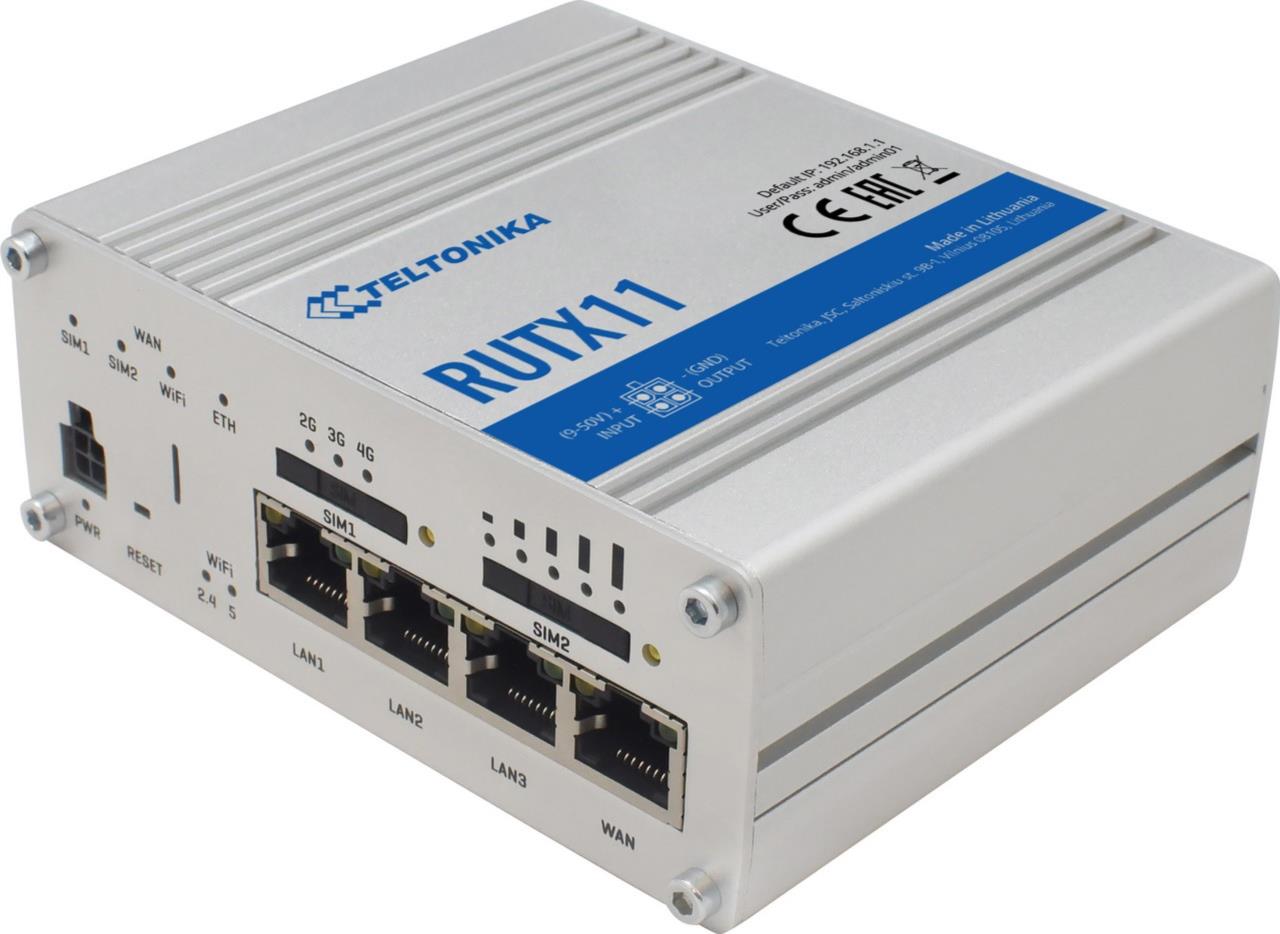
Teltonika RUTX11
Dual-SIM router from the RUTX series — the model from Bondix's own retail case study for bonding at the till.

Teltonika RUTX50 (5G)
5G-capable dual-SIM router from the RUTX series for sites with high bandwidth needs.
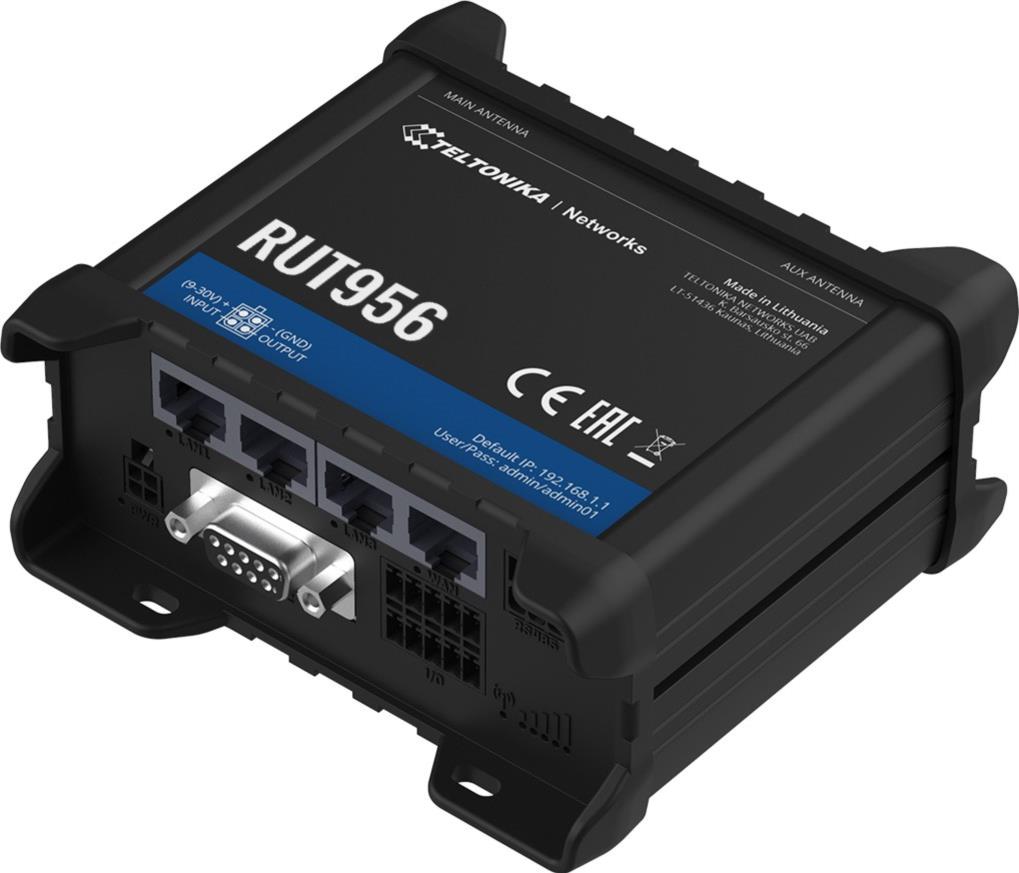
Teltonika RUT956
Industrial dual-SIM router with Ethernet, GNSS and serial interfaces for use in a cabinet.
Further reading
- WAN bonding becomes a router app: Bondix in the Teltonika Package Manager
- Teltonika RMS or your own VPN? Remote access and remote management compared
- Internet in your RV: Starlink, a 5G router — or both?
- Teltonika Bonding: partnership with Bondix Intelligence
- VPN Hub Hosting at Ascend
- Unlimited data volume on the move
- Router for SIM cards at Ascend
- Multi-WAN bonding with Viprinet
This article was researched and written with AI assistance and reviewed by Ascend before publication.
Ready for your next project?
Talk to our team about your requirements.
Related posts

Internet in Your RV: Starlink, a 5G Router — or Both?
Starlink or a 5G router for your RV? It depends on where you're parked and for how long. Coverage, power draw and cost compared – and when combining the two pays off.

WAN Bonding Becomes a Router App: Bondix Is the First Third-Party Software in the Teltonika Package Manager
WAN bonding used to mean a dedicated appliance. With Bondix in the Teltonika RutOS Package Manager, it becomes a package you install on the router in a few clicks.
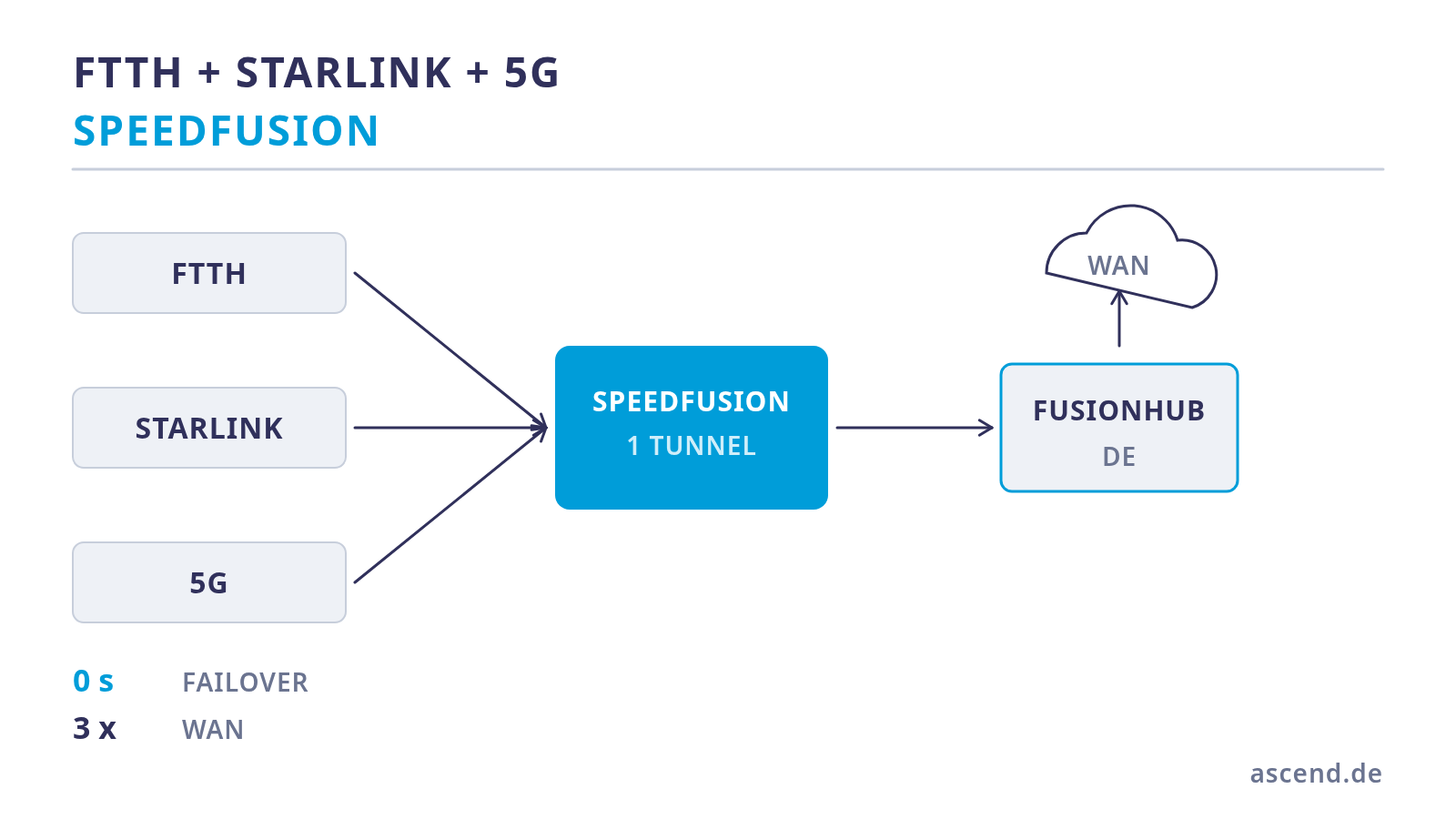
Bonding fibre, Starlink and 5G: three paths for a live studio
Three lines are only redundancy if they fail independently of one another. How to bond fibre, Starlink and 5G in one tunnel, why the number of WAN ports is the first hard limit, which pitfalls Starlink brings with it — and what that means for the power supply.