





Internet in Your RV: Starlink, a 5G Router — or Both?

Introduction
Internet in your RV is no longer a side issue – for many travellers, it's the precondition for working from the road, video calls, or even just checking the weather away from town. The honest answer to "Starlink or a 5G router?" is: it depends on where you're parked and for how long. If you're mostly on campsites and in towns, a good 5G router will usually cover you completely. If you regularly park well away from any network coverage, there's not much way around a satellite connection like Starlink. And if you work on the road and simply can't afford a dropout, the answer isn't either option alone, but a combination of both.
Teltonika Networks compared the two approaches on 8 September 2026 in its own newsroom article. In this article, we put the figures given there into practical context for use in a motorhome — and explain why the point that actually matters for vehicles isn't top speed, but power draw, because that feeds straight through to your leisure battery.
Starlink in your RV: what the satellite connection delivers — and what it needs
Starlink's big advantage is reach: as long as the terminal has a clear view of the sky, you can get internet access at many remote locations — that's how Teltonika describes it in its own comparison. In everyday RV life, though, that condition isn't always met. Trees, buildings and surrounding terrain affect performance, according to Teltonika — so a densely wooded pitch or a narrow street between buildings can noticeably reduce performance, even if you're parked "out in the green" or right in the middle of a town.
On the cost side, Starlink consists of two components: the satellite hardware and a monthly subscription. We deliberately don't quote specific amounts here – tariffs change, and it's best to check current prices directly with the provider. A more important point for trip planning is a different one: at your destination, Starlink needs the satellite equipment set up – the terminal has to be positioned with a clear view of the sky before the connection is established. That's a different amount of effort for a short stopover than for several days on the same pitch.
A 5G router in your RV: flexible, but dependent on network coverage
A 5G router takes the opposite approach: it's designed for seamless vehicle installation — either on a DIN rail or surface-mounted — combines mobile data, campsite Wi-Fi and wired connections, and switches between these paths if one of them isn't available. On the cost side, you pay once for the hardware and then for your mobile operator's data plan — with no additional satellite subscription. You'll find details of our own data plan offer for life on the road on our page Unlimited data volume on the move.
On speed, it's worth reading the small print carefully: Teltonika states up to 3.4 Gbps 5G download speed for the RUTM50 and RUTC50 5G routers. This is a manufacturer figure for a theoretical ceiling — not a speed you'll actually reach on a real pitch while travelling. Network load, distance to the nearest mobile mast and the actual 5G coverage available at the site determine what really arrives at your pitch. The RUTM50 is currently only available to a limited extent from us, the RUTM52 and RUTC50 currently have no dedicated product page, and the RUTM54 is not currently available. For practical use in an RV, we therefore recommend the 5G models actually available in our range — such as the Teltonika RUTX50 or the Teltonika RUTM55.
The point that actually matters for vehicles: power draw and the leisure battery
Speed comparisons are less meaningful for a purchase decision in an RV than they sound – the bandwidth you can actually use depends on your location anyway, not on the technical maximum. What's more practically relevant is a figure that product comparisons often overlook: power draw in continuous operation.
Teltonika puts figures on it: a 5G router draws around 5 to 12 watts, while Starlink continuously draws around 25 to 60 watts — both manufacturer figures from the Teltonika article referenced above, not measurements of our own. In an RV, that difference isn't a side issue: unlike on a fixed mains connection, every watt on your on-board electrical system comes directly out of your battery capacity and — unless you're driving or plugged into mains power – out of your solar set-up. A device that continuously draws towards the upper end of around 60 watts drains a leisure battery noticeably faster overnight than one that gets by on a fraction of that. If you're parked away from mains power for several days, you should therefore take this figure at least as seriously as the coverage question – it has a direct bearing on how long your leisure battery lasts without recharging.
The manufacturer's recommendation: combine Starlink and a 5G router
At the end of its own comparison, Teltonika itself states a clear recommendation: combining Starlink with a Teltonika 5G router produces a more resilient set-up. Instead of relying on a single network, travellers can switch between the different connection paths depending on location and network availability, according to the manufacturer.
It's worth being clear about what "combining" actually means here: in its simplest form, that just means switching — if one path fails, the other takes over, but the two connections aren't used together. We explain in detail how mere switching becomes genuine bonding, where both paths contribute to a session at the same time, in our article WAN bonding becomes a router app — that article is primarily about fixed sites, but the principle of failover, load balancing and genuine bonding applies just the same in a vehicle.
Which solution suits your travel style? A decision path
The following rule of thumb is based on your actual travel behaviour, not on best-case technical figures:
- Mostly campsites and towns: a 5G router is usually enough. You benefit from lower power consumption, simpler installation, and the fact that you're usually within reach of good mobile networks anyway.
- Regularly parked well away from civilisation: this is where Starlink shows its strength, because mobile networks are often simply absent at such locations — provided the terminal has a clear view of the sky.
- You work on the road, and a dropout is unacceptable: then neither Starlink nor the 5G router alone is the right answer, but the combination of both — exactly the recommendation Teltonika itself makes.
Naturally, there are grey areas between these three cases. When in doubt, it helps to ask what a dropped connection actually costs: a missed video call is annoying, whereas a live payment transaction or a livestream can be expensive. The higher that cost, the more the extra safeguard is worth it.
Power and installation in practice: mounting, antenna position, continuous load
For the 5G router: the form factor designed for vehicle installation — DIN rail in a cabinet or surface mounting — is built for a fixed installation, much like in industrial set-ups. The same rule applies to antenna position as everywhere else: as high as possible and as free as possible from metal bodywork parts that attenuate the signal.
Starlink, by contrast, genuinely needs space and a clear line of sight: the terminal has to be set up fresh every time you change pitch, and trees or buildings nearby directly affect performance, as described above. If you're combining both systems, it's best to plan for two separate mounting points from the outset: a fixed spot for the router inside the vehicle or in a storage compartment, and a flexible position for the Starlink terminal that can be set up and taken down quickly. You should factor the continuous load on your leisure battery into the sizing of your solar set-up and battery capacity from the start, rather than retrofitting for it afterwards.
Conclusion: it depends on your pitch
There is no blanket answer to "Starlink or a 5G router in your RV" — there's only the answer that suits your travel style. If you're mostly on campsites and in towns, a 5G router will do the job and save you power consumption and installation effort. If you're regularly parked well away from things, there's not much way around Starlink — but you'll need to plan for sky visibility, set-up effort and higher power draw. And if you need both, because a dropout simply isn't an option, the best approach is to follow the manufacturer's recommendation and combine the two.
From our range, the Teltonika RUTX50 (462,00 €) is particularly suited to vehicle installation, and — for higher interface demands — the Teltonika RUTM55 (520,02 €); as a lower-cost 4G/LTE entry point, the Teltonika RUT241 (148,68 €) is available. If you're unsure which combination suits your route, get in touch — we'll advise you on device choice, installation and data plan, without selling you a bundle you don't need.
Starlink, 5G router or combination compared
| Starlink | 5G Router | Combination | |
|---|---|---|---|
| Coverage off the beaten track | Possible with a clear view of the sky; trees, buildings and terrain affect performance | Depends on available mobile coverage at the site | Uses whichever path is available, depending on location |
| Power draw | Around 25–60 watts in continuous operation (Teltonika figure) | Around 5–12 watts (Teltonika figure) | Higher than a single path, since both systems are operated |
| Cost model | Satellite hardware plus monthly subscription | One-off hardware plus your mobile operator's data plan | Hardware and tariff costs for both systems |
| Set-up & installation | Setting up the satellite equipment needed at every pitch change | Designed for vehicle installation: DIN rail or surface mounting | Two separate mounting points for router and terminal |
| Behaviour on failure | No fallback if sky view or equipment is unavailable | No fallback if there's no mobile coverage | Switches between paths depending on location and availability |
| Suited to | Locations away from any network coverage, longer stays | Campsites, towns, short stopovers | Working on the road, when a dropout is unacceptable |
Frequently asked questions
Request advice
Planning the internet set-up for your RV and unsure whether Starlink, a 5G router, or a combination of both suits your travel style? We advise you on device choice, installation and data plan.
Matching 5G routers at Ascend
Available Teltonika 5G routers for vehicle installation — see availability and current prices on the product page.

Teltonika RUTX50 (5G)
5G dual-SIM router with dual-band Wi-Fi 5 and GPS – compact enough for vehicle installation.

Teltonika RUTM55 5G Industrie-Router
5G industrial router with dual-SIM and RS232/RS485 interfaces – for set-ups with higher demands on robustness.
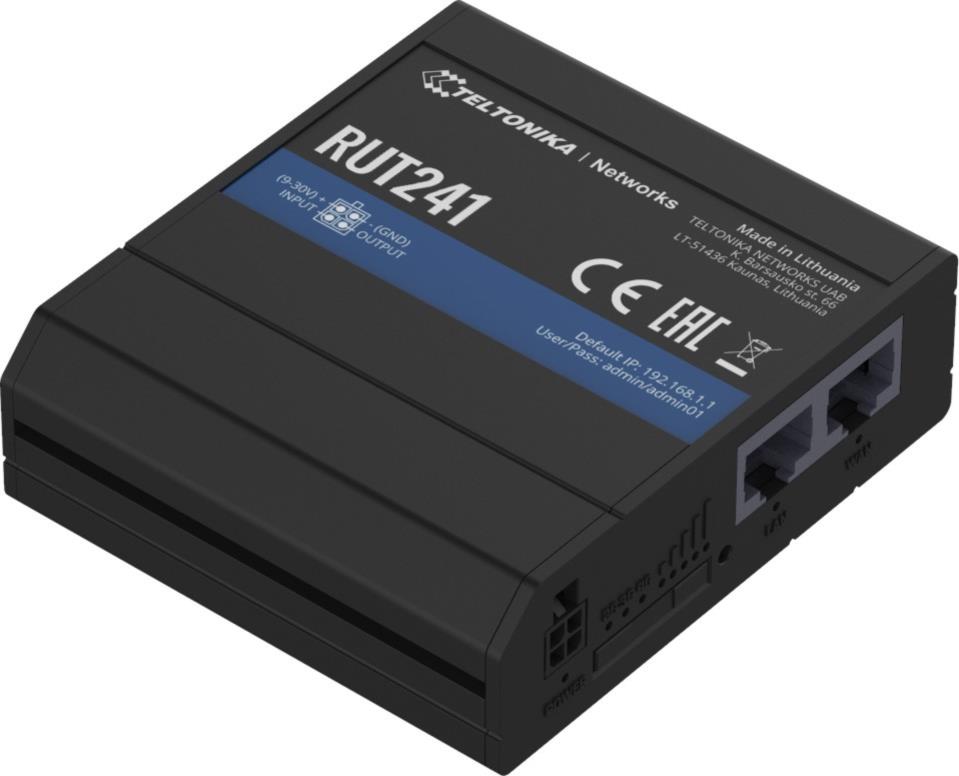
Teltonika RUT241
Compact 4G/LTE Wi-Fi router with Ethernet and I/O – the lower-cost entry option when 4G/LTE is enough for your route.
Further reading
- WAN bonding becomes a router app: Bondix in the Teltonika Package Manager
- Router, bonding, data plan: the three building blocks of a resilient connection
- Teltonika routers at Ascend
- Unlimited data volume on the move
- Fibre, Starlink, 5G: bonding in the livestream studio
- Starlink, 4G, 5G: a stable network with Ascend
- Teltonika at the Ascend Shop
This article was researched and written with AI assistance and reviewed by Ascend before publication.
Ready for your next project?
Talk to our team about your requirements.
Related posts

Router, Bonding, Data Plan: The Three Building Blocks of a Resilient Connection
A router with no second path, two paths without bonding, two SIM cards on the same network: a resilient connection depends on all three building blocks working together.

WAN Bonding Becomes a Router App: Bondix Is the First Third-Party Software in the Teltonika Package Manager
WAN bonding used to mean a dedicated appliance. With Bondix in the Teltonika RutOS Package Manager, it becomes a package you install on the router in a few clicks.
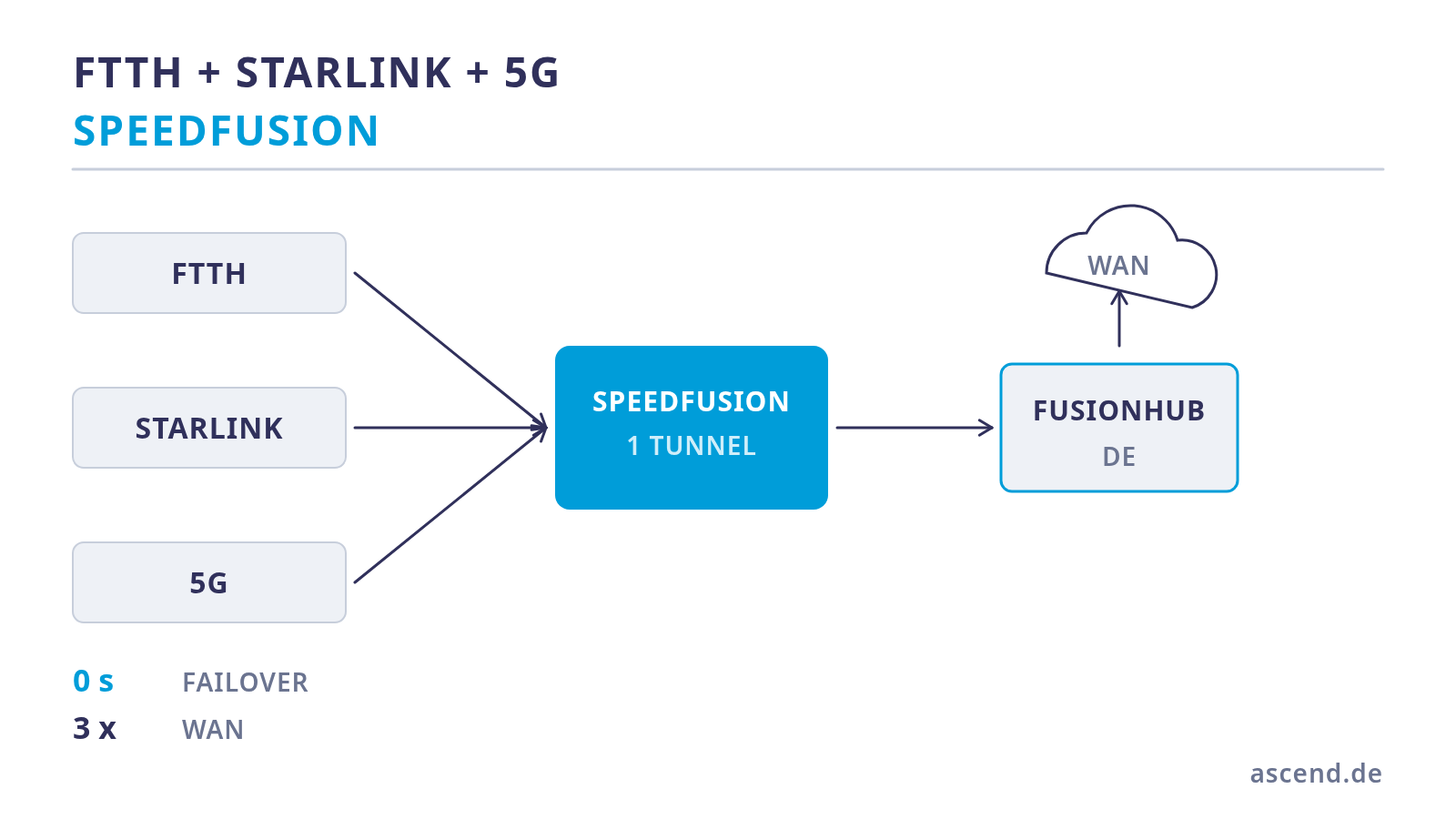
Bonding fibre, Starlink and 5G: three paths for a live studio
Three lines are only redundancy if they fail independently of one another. How to bond fibre, Starlink and 5G in one tunnel, why the number of WAN ports is the first hard limit, which pitfalls Starlink brings with it — and what that means for the power supply.