


Orbit WAN: Peplink's New Satellite Integration with Starlink and OneWeb

Introduction
For the teams running networks in the hardest places — offshore vessels in the North Sea, pipeline compressors two hundred kilometers from the next radio mast, disaster-relief units setting up incident command in a flooded valley — satellite has long ceased to be the option of last resort. It is a primary WAN. The problem was never bandwidth. Starlink delivers it. OneWeb delivers it. The problem is managing the satellite like any other WAN: seeing it, applying health checks to it, failing over from it and — most importantly — bonding it with the terrestrial links so that a dish handoff or a brief obstruction does not interrupt the video call, the SCADA query or the telemetry stream.
This is exactly the gap that Peplink Orbit WAN closes. Introduced in Firmware 8.6.0, it is Peplink's satellite control panel — a generalized, API-driven framework that treats a satellite terminal as a full-fledged, natively managed WAN. The router speaks the dish's protocol, shows its state in the same dashboard as fiber and cellular, and folds it into SpeedFusion bonding as if it were just another Ethernet pipe. From 8.6 that means Starlink and OneWeb — the architecture is designed to accommodate further constellations once they reach market maturity.
This article explains what Orbit WAN is, what it replaces and why it matters when your network ends where the asphalt does.
From Starlink Mode to Orbit WAN — the evolution
Peplink's satellite story does not begin with Orbit WAN. It begins with Starlink Mode — a pragmatic feature that answered a simple question: "If a Starlink dish hangs off a WAN port, can the router manage it natively instead of treating it as a dumb Ethernet handoff?"
The answer was yes. With Starlink Mode, you connected the dish via the official Ethernet adapter, opened the WAN details in the Peplink admin interface and switched the mode on. The router began speaking the Starlink dish's API directly. Dish status, obstruction maps and health telemetry appeared in the WAN details and in InControl 2 — the same cloud platform you were already using for the rest of the Peplink fleet. No more separate Starlink app to open when the link degraded. No more guessing whether the dish or the router was the problem.
Starlink Mode also introduced a deceptively important option: "Ignore Starlink outages." Satellite WANs fail differently than wired ones. A fiber outage is usually a clean, binary event — the link is up or down, and you fail over. A Starlink dish experiences short, frequent, self-healing interruptions: a satellite handoff between overhead passes, a few seconds of obstruction from a funnel or radar mast, a brief network event in the space segment. With standard health checks, these blips read as a WAN outage and trigger failover — which seconds later triggers a failback as the dish recovers. The failover logic flaps all day. The "Ignore Starlink outages" option instructed the router to tolerate these transient events and hold the primary path.
Starlink Mode was Starlink-specific. It worked well — so well that customers asked the obvious follow-up question: "What about OneWeb? What about the next constellation?" Firmware 8.6.0 is the answer. Peplink has generalized the Starlink Mode panel into Orbit WAN — a constellation-agnostic satellite management framework — and added OneWeb as the first natively integrated second constellation. The evolution is architectural: Orbit WAN is built as a panel that can absorb further satellite providers as they mature, rather than a one-off feature bolted onto a single dish.
What native satellite management delivers
The difference between "the dish works" and "the dish is managed" is the difference between a network you can operate and one you can only troubleshoot. Orbit WAN delivers three concrete capabilities.
Dish telemetry where you are already looking
With Orbit WAN enabled, satellite status appears directly in the WAN details in the local admin interface and in InControl 2 in the cloud — alongside the cellular, fiber and Wi-Fi WANs. You see dish health, signal quality and stability indicators in the same view. For a maritime operator running a fleet of vessels, that means: a single dashboard shows the Starlink dish on the bridge, the OneWeb terminal at the stern, the cellular backup on the mast — all with live telemetry. No tab switching. No "let me just open the Starlink app" while the chief engineer asks why the ECDIS chart update is stuck.
Sensible health checks
Firmware 8.6.0 tuned the satellite-specific health checks to match the actual behavior of satellite links. The practical effect: transient dish events — a handoff, a brief obstruction, a passing congestion spike — no longer register as a WAN outage. The router holds the link, the event passes, and the failover logic stays calm.
Bonding that understands satellite
Because the satellite WAN is natively managed — the router knows it is a dish, not a generic Ethernet port — it can be folded into a SpeedFusion tunnel alongside cellular and further WANs. WAN Smoothing and the new SpeedFusion Boost algorithm address the instabilities inherent to satellite — Smoothing through packet duplication, Boost through isolating unstable links. The result is a bonded tunnel that delivers the aggregated bandwidth of satellite plus cellular — with the stability of whichever link is healthiest. For a disaster-relief incident command vehicle, that means: the bonded tunnel keeps streaming body-cam feeds while the Starlink dish hands over between satellites — the cellular leg bridges the gap.
A field note worth repeating: with standard health checks, a satellite dish can keep the failover logic flapping all day. Use the outage tolerance of the native mode. And if the site is critical, do not fail over at all — bond the dish with cellular and let SpeedFusion smooth over the handoffs. No failover is the real point.
OneWeb integration — the second constellation
If Starlink Mode proved the concept, the OneWeb integration proves the architecture. OneWeb — Eutelsat OneWeb's Low Earth Orbit constellation — is the second satellite provider natively integrated into Orbit WAN from Firmware 8.6.0 onward. For enterprise, government and maritime buyers, this is not a nice-to-have. It is a procurement requirement. Operations teams that do not want — and in many cases contractually cannot — tie critical connectivity to a single satellite provider now have two natively managed LEO options in the same router, managed via the same panel, visible in the same dashboard.
OneWeb terminals deliver Ethernet natively, which simplifies physical installation: you connect the terminal's Ethernet to a WAN port, enable the OneWeb satellite mode in the Orbit WAN panel, and the router begins managing it. Telemetry, health checking and bonding integration work exactly as with Starlink — the Orbit WAN framework is designed to be constellation-agnostic.
A hardware note: the OneWeb integration is supported on all Peplink models with the exception of the HD1 Dome Pro. Anyone standardizing on OneWeb as a primary or diversity path should verify the hardware list against the 8.6.0 supported-devices matrix before specifying. As a Peplink Gold Partner, Ascend validates the hardware fit for your specific combination.
The strategic point is simpler: Orbit WAN is built to absorb further constellations as they arrive. The panel is a framework, not a feature. When the next LEO or MEO provider matures to enterprise-grade handoff and telemetry APIs, the architecture is ready to absorb it.
Bonding satellite with cellular — the SpeedFusion Boost advantage
Native management and telemetry are necessary but not sufficient. Orbit WAN's real differentiator is what it enables in combination with SpeedFusion Boost — the new bonding algorithm introduced in Firmware 8.6.0 in parallel.
The problem Boost solves is fundamental to multi-orbit networking: when you bond connections with dramatically different speed, latency and reliability characteristics, a single unstable link can drag down the entire tunnel. During a handoff, a dish briefly degrades; a classic bonding algorithm that waits for all packets makes the entire tunnel feel sluggish. SpeedFusion Boost takes a different approach — it improves throughput over bonded WAN connections by preventing unstable links from dragging down overall performance. Even when individual connections are affected by satellite handoffs, temporary obstructions, congestion or weather, these disruptions have less impact on the aggregated bonded WAN.
The most striking real-world figure comes from a field report by the Peplink specialist portal Connectivity101: in bonded Starlink configurations with Boost enabled, close to 1.5 Gbps of aggregated throughput was observed across multiple terminals. This is a third-party field observation, not an official performance specification from Peplink.
For the audiences this matters most to:
- Maritime: a vessel bonding two Starlink terminals with a OneWeb diversity path and a cellular backup for coastal passage. Boost keeps crew Wi-Fi, engine-monitoring telemetry and video backhaul online through satellite handoffs and weather.
- Remote industry: an offshore platform bonding Starlink with cellular. The bonded tunnel delivers aggregated bandwidth for SCADA, voice and video inspection feeds — with Boost isolating cellular congestion spikes so they do not degrade the satellite primary.
- Public safety: an incident command vehicle bonding a Starlink dish with multiple cellular carriers. When the vehicle drives behind a building and a cellular leg degrades, the bonded tunnel does not stutter — Starlink and the remaining cellular legs carry the load.
The combination of Orbit WAN's native satellite management and SpeedFusion Boost's bonding intelligence is the core of the architectural advancement in Firmware 8.6.0 for satellite-heavy deployments. It is what turns "we have satellite" into "we have a managed, bonded, multi-orbit WAN". You can find more on how SpeedFusion Boost works in our SpeedFusion Boost deep dive; the bonding fundamentals are explained in our article Multi-WAN bonding briefly explained.
Hardware for multi-orbit — the MAX Orbit series
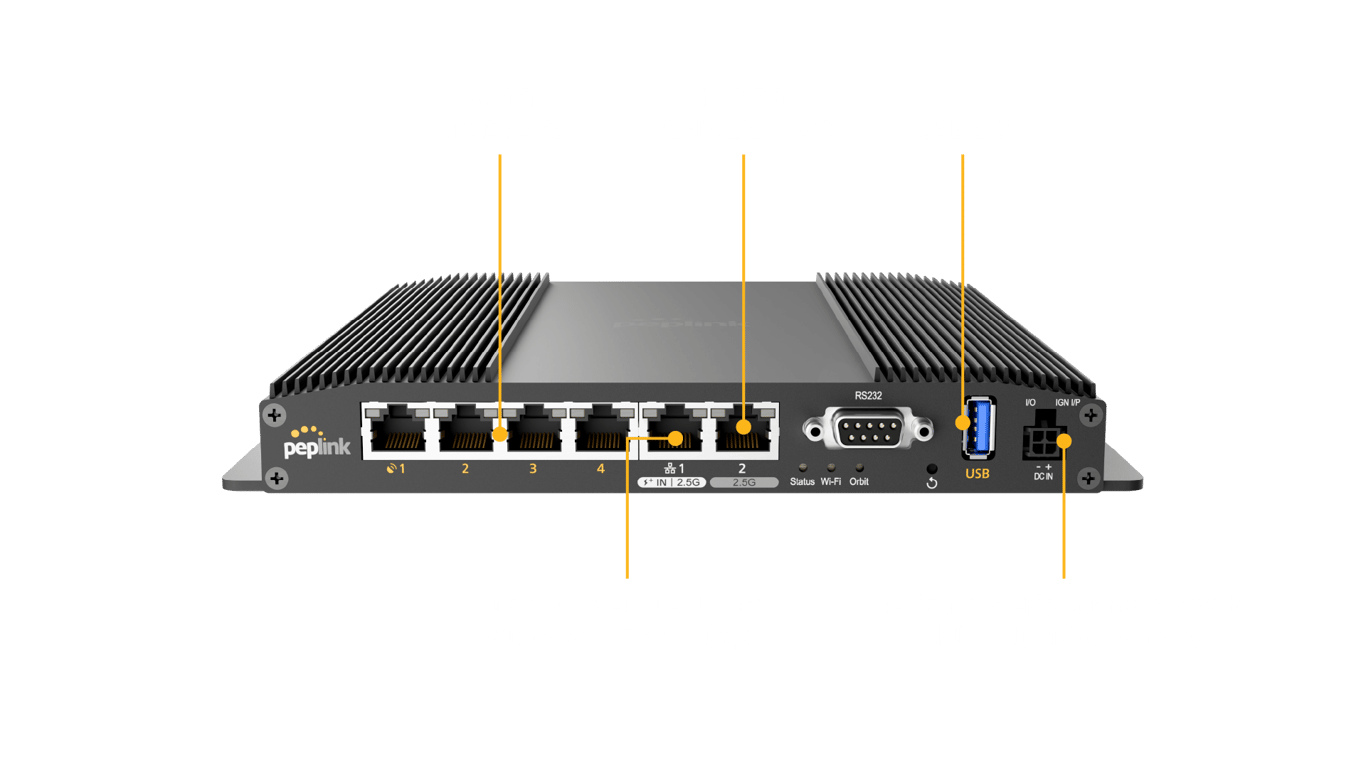
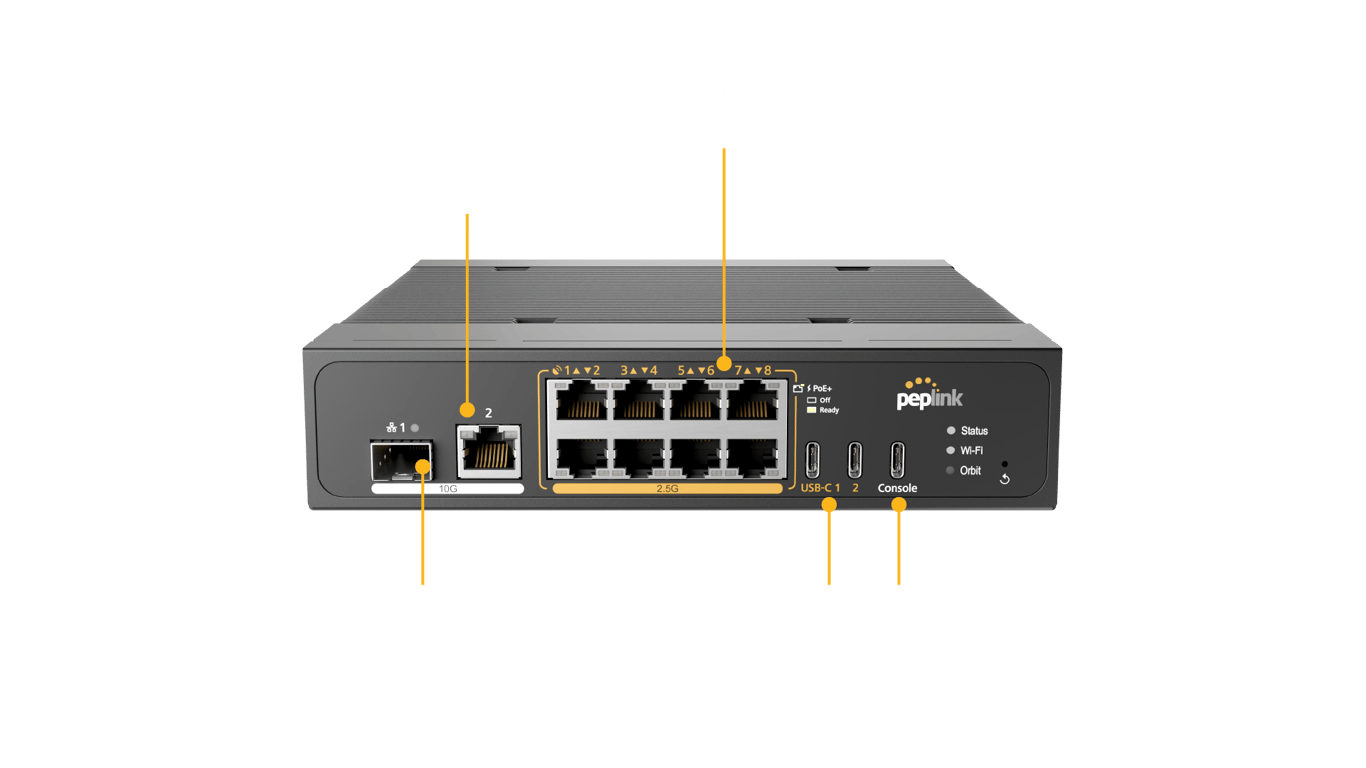
Every Peplink router with a free WAN port can take on a satellite terminal — that is the virtue of Orbit WAN as a firmware feature without hardware lock-in. But some hardware is built for the task from the ground up. The MAX Orbit series — the Orbit 2, Orbit 4 and Orbit 8 — is Peplink's purpose-built multi-orbit router line, engineered for deployments where satellite is the primary WAN, not the backup.
The Orbit series is designed to bond Starlink, OneWeb and cellular simultaneously over SpeedFusion — with built-in GPS for mobile and maritime positioning and rugged enclosures certified for the environments where multi-orbit connectivity actually matters. The series spans three sizes (Orbit 2, Orbit 4, Orbit 8) for differently dense multi-orbit setups; the specific specifications per model are listed by Peplink on the product page.
For maritime operators, the Orbit series is the natural choice: a vessel that wants Starlink as primary, OneWeb as diversity and cellular for coastal passage can run all three over a single router — managed in one dashboard, with SpeedFusion Boost for the handoffs. For remote industrial sites, the Orbit series provides the WAN density and bonding throughput to aggregate satellite and cellular into a highly available tunnel. For public safety, the rugged enclosures and built-in GPS make the Orbit series suitable for mobile incident command vehicles that need a bonded multi-orbit WAN within minutes of arrival.
If you would like to learn more about Peplink's 5G architecture, which is particularly relevant in combination with satellite, our article Peplink 5G retrofits: Why four antenna paths? offers further explanations.
If satellite is your primary, not your backup, then the Orbit series is the hardware line you should specify. Talk to Ascend — as a Peplink Gold Partner we design the entire stack: hardware selection, Orbit WAN configuration, SpeedFusion bonding design and ongoing InControl 2 management.
Conclusion
Peplink Orbit WAN is not a satellite feature. It is a WAN management philosophy: treat the satellite terminal like any other WAN — natively, with telemetry, with tuned health checks and with bonding integration — and satellite stops being the fragile, special-case link operators tolerate and becomes a managed member of the edge network. Firmware 8.6.0 delivers this philosophy with Starlink and OneWeb as the first two integrated constellations, SpeedFusion Boost as the bonding engine that makes multi-orbit aggregation real at speed, and the MAX Orbit series as the hardware built for it.
Whether you run a maritime fleet, a remote industrial network or a public-safety deployment where satellite is primary — the question is no longer whether you can manage and bond satellite WANs. With Orbit WAN, you can. The question is whether your current architecture is already exploiting that.
Ready to design your Orbit WAN deployment? As a Peplink Gold Partner, Ascend delivers the entire stack — from hardware selection through SpeedFusion bonding design to InControl 2 fleet management. Contact us to plan your multi-orbit architecture. You can find more articles on Peplink Firmware 8.6.0 in our Peplink blog category.
Frequently asked questions
Plan your multi-orbit architecture
We design the entire stack: hardware selection, Orbit WAN configuration, SpeedFusion bonding design and ongoing InControl 2 management.
Matching Peplink products
Matching hardware directly from the Ascend Shop — availability and prices are shown on the product detail page.

Further reading
This article was researched and written with AI support and reviewed before publication by Ascend's Peplink-certified engineers.
Ready for your next project?
Talk to our team about your requirements.
Related posts
Upgrading to Peplink Firmware 8.6.0: The Complete Guide
Peplink upgrade guide for Firmware 8.6.0: staged upgrade paths, FIPS and PSK requirements, certificate modernization, retired models and post-upgrade checklist.

WireGuard on Peplink: Modern VPN Remote Access Arrives with Firmware 8.6.0
Peplink Firmware 8.6.0 brings WireGuard VPN for Remote User Access on all models. Comparison with OpenVPN and L2TP, deployment recommendations and SFC Direct Access.
Peplink 8.6.0 Cellular & 5G: Multi-APN, 5G SA and Four eSIM Profiles
Peplink 8.6.0 brings Multi-APN on 5GN, 5G Standalone on 5GD, IPv6 on five module families and up to four eSIM profiles per modem. Overview for cellular and IoT deployments.