


Teltonika TSW2 switches compared: TSW200, TSW210, TSW202 or TSW212?
Introduction
Teltonika switches are designed for industrial network applications where reliability, longevity and long-term performance are essential — in factories, transport systems, energy infrastructure and other demanding environments. TL;DR: TSW200 for unmanaged networks with PoE, TSW210 for unmanaged networks without PoE, TSW202 for managed networks with PoE+, TSW212 for managed networks without PoE — all four with 8 gigabit ports and 2 SFP slots.
The main difference between the Teltonika switches lies in the network management functions, PoE support and the respective use case. Unmanaged TSW2 devices offer simple plug-and-play Ethernet connectivity, managed switches of the series provide extended network control such as VLANs and traffic management — and PoE-capable models transmit power and data over the same Ethernet cable.
Teltonika published its own comparison guide for the TSW2 series in August 2026 ("Teltonika switches: TSW series comparison guide"). This article summarises the key statements, adds the hard specifications from the official datasheets and answers the question: which TSW2 switch is the right one for your application?
The Teltonika TSW2 series at a glance
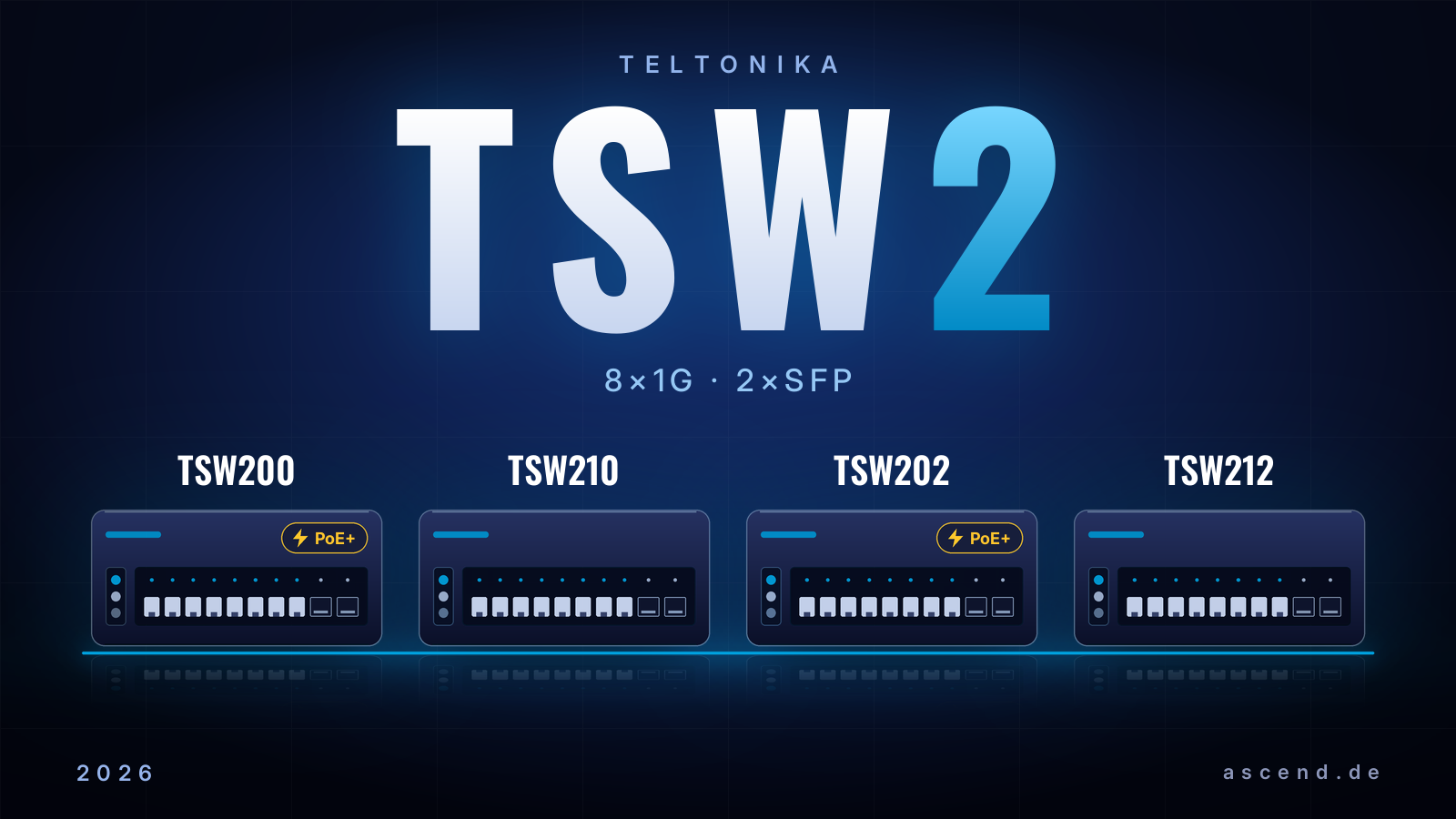
The industrial Teltonika TSW2 Ethernet switch series is designed for different levels of network complexity — from simple device connections to complex industrial infrastructures. The portfolio comprises four models:
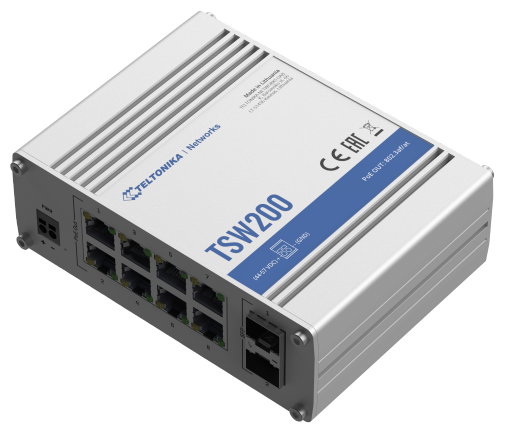
- TSW200 — an unmanaged PoE switch, developed for applications where connected devices need both data connectivity and power supply.
- TSW210 — an unmanaged industrial Ethernet switch, designed for reliable network expansion.
- TSW202 — a managed PoE+ switch combining network control with power-supply functions.
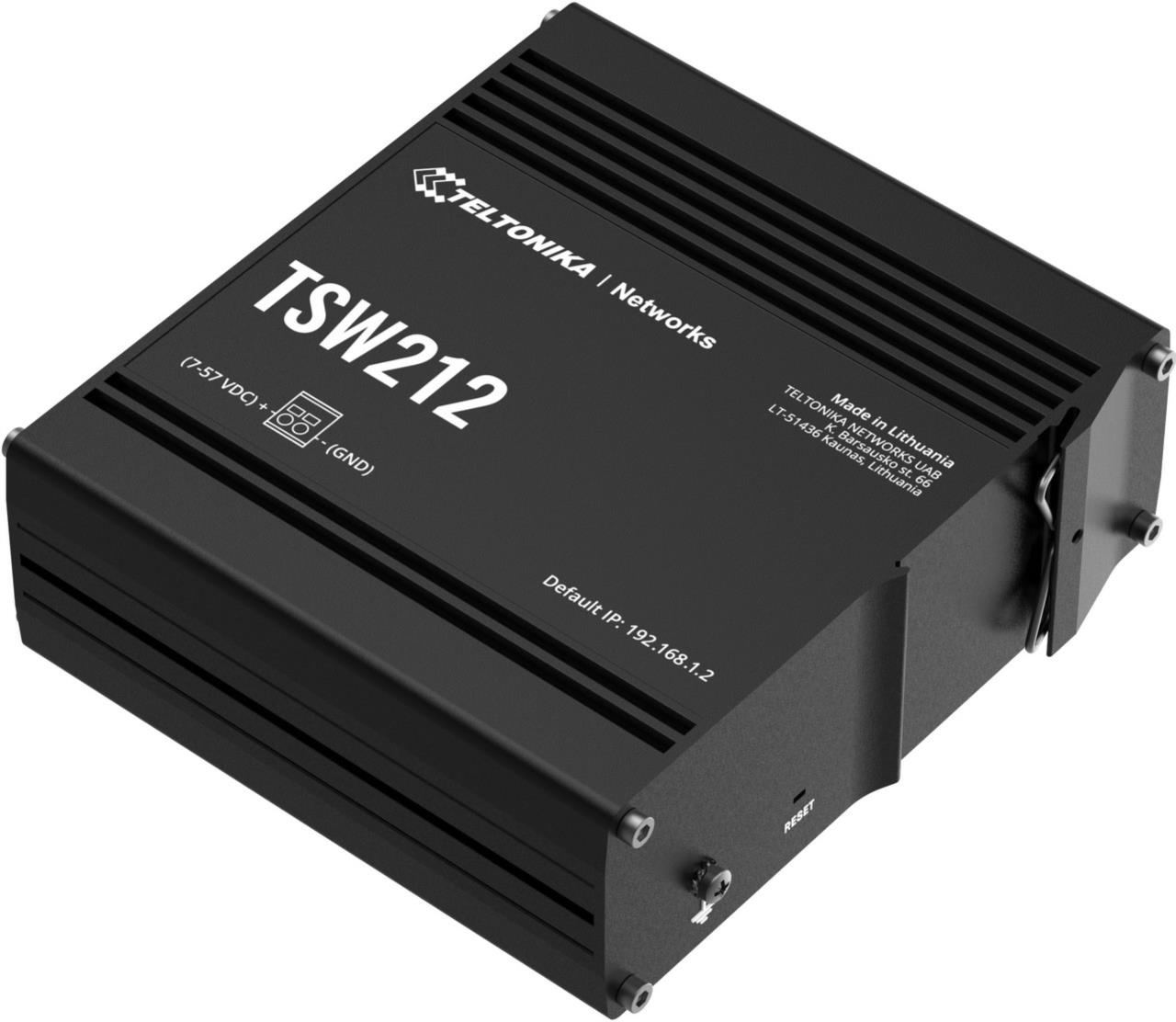
- TSW212 — a managed industrial Ethernet switch for applications requiring advanced network configuration and administration.
What unites all four is shown by the official datasheets: each has 8 RJ45 ports with 10/100/1000 Mbps, 2 SFP ports for long-range fibre-optic communication, an input voltage range of 7–57 VDC, operating temperatures from −40 °C to +75 °C, ingress protection IP30 and a robust aluminium housing. These are the industrial basic virtues of the series — the difference lies exclusively in the feature set on top.
The most important decision between the models depends, according to Teltonika, on whether the network needs PoE, management functions, or both.
PoE or not, managed or not — the two basic decisions
Before comparing model names, it is worth looking at the two basic questions — they sort the series immediately:
Question 1: Do your end devices need Power over Ethernet? PoE transmits power and data over a single cable. It simplifies installation, reduces the need for additional power infrastructure and is worth its weight in gold wherever devices hang that have no supply of their own — IP cameras, wireless access points, industrial IoT devices. If you need this, the choice narrows to TSW200 or TSW202. If your devices supply themselves, TSW210 and TSW212 remain.
Question 2: Do you need control over the data traffic? Unmanaged switches work as plug-and-play: connect, done. Managed switches allow VLANs, traffic prioritisation (QoS), port isolation, STP/RSTP against loops, static IPv4/IPv6 routing and remote management via RMS and FOTA — running on the OpenWrt-based operating system TSWOS. As soon as your network grows, separates departments or protocol worlds, or industrial protocols like PROFINET come into play, a managed switch is the right foundation.
The model almost emerges from the two answers by itself — and that is exactly what the series is designed for: one switch for every combination of PoE yes/no and managed yes/no.
TSW200 and TSW210: the choice between PoE and standard Ethernet
The Teltonika TSW200 and TSW210 are designed for users who need reliable industrial Ethernet connectivity without extended network management. Both models have two SFP ports for long-range fibre-optic communication, enabling reliable connections over greater distances using fibre-optic cables.
The TSW200 suits environments where connected devices must be powered over the Ethernet connection. According to the datasheet it delivers PoE+ per IEEE 802.3af/802.3at with up to 30 W per port and a total budget of 240 W — enough for a full set of cameras or access points on one switch. For PoE feeding, the input voltage is 44–57 VDC; the non-blocking bandwidth is 10 Gbps, the MAC table holds 2K entries. Typical application areas according to Teltonika:
- IP surveillance systems
- Wireless access points
- Industrial IoT devices
- Remote monitoring solutions
The TSW210 is designed for applications where the connected devices already have their own power supply — accordingly it delivers no PoE. The datasheet shows a lean power consumption of 1.03 W idle and 3.71 W maximum, plus a non-blocking bandwidth of 20 Gbps. Typical application areas according to Teltonika:
- Industrial controllers
- Automation systems
- Ethernet-connected machines
- Network expansions
The choice between TSW200 and TSW210 therefore hinges on a single question: must the power supply be part of the network connection — or not?
TSW202 and TSW212: managed industrial switches compared
For more demanding network requirements, Teltonika offers managed switches that allow more precise control of industrial communication. Both models have 2 SFP ports for long-range fibre-optic communication and thus scalable, reliable fibre connections in industrial environments.
The TSW202 combines managed-switching functions with PoE+ capability, making it suitable for installations that require both network management and power supply. Like the TSW200, it feeds up to 30 W per port (IEEE 802.3af/802.3at Alternative B) with a total budget of 240 W, per the datasheet. On top come 20 Gbps non-blocking bandwidth, a 14.88 Mpps forwarding rate, 8K MAC entries and a 512 KB packet buffer. Typical application areas according to Teltonika:
- Smart infrastructure
- CCTV networks
- Industrial IoT implementations
- Networks with several active devices
The TSW212 specialises in managed industrial Ethernet connectivity — the solution for applications where network organisation, monitoring and configuration matter, but no PoE supply is needed. Technically it shares the TSW202's managed platform (20 Gbps non-blocking, 8K MAC entries, 512 KB packet buffer) but does without PoE end-device supply — with correspondingly lower power consumption (<2.5 W idle / 6 W max.). Typical application areas according to Teltonika:
- Production environments
- Industrial automation
- Infrastructure networks
- Complex Ethernet implementations
The main difference between the two models: the TSW202 is optimised for managed networks with PoE requirements, while the TSW212 focuses on managed industrial Ethernet connectivity.
What managed TSW2 switches can do concretely
What exactly does "managed" mean for the TSW2 series? The datasheets of the TSW202 and TSW212 list an extensive feature set, operated with the OpenWrt-based operating system TSWOS:
- Layer 2: VLAN, STP/RSTP, loop protection, port isolation, port mirroring, MAC table with 8K entries
- Layer 3: static IPv4 and IPv6 routing, DHCPv6 client, static IPv6 addresses
- QoS: port, DSCP and 802.1p prioritisation, TOS, scheduling per SP/WFQ/WRR, rate limiting, storm control, port-based traffic shaping
- Industrial protocols: PROFINET (Class B), EtherNet/IP, MRP (client and manager role), LLDP
- Management & diagnostics: SNMP v2/v3, DHCP server/client, cable diagnostics, ping, traceroute, nslookup
- Remote maintenance: RMS integration and FOTA updates, firmware updates without losing the configuration, SDK package for own developments
For automation networks, PROFINET Class B and EtherNet/IP are the decisive keywords: the switch integrates directly into the control world instead of standing beside it. And anyone operating fleets gets the same management model with RMS and FOTA that Teltonika routers use — one interface for the entire inventory.
Practical tip: If you are connecting PROFINET or EtherNet/IP controllers today, or plan to separate network segments via VLAN in the medium term, plan with TSW202/TSW212 from the start. A later switch from unmanaged to managed means device and configuration effort that the right initial decision avoids.
All four models in direct comparison
The comparison of all four models by datasheet values:
A note on mounting: the unmanaged models TSW200 and TSW210 need an additional kit for DIN or wall mounting; the housings can also be placed free-standing on flat surfaces. The TSW202 and TSW212 already include the DIN-rail bracket. If mounting accessories matter in your project, clarify the right variant before ordering — Ascend will support you.
| TSW200 | TSW210 | TSW202 | TSW212 | |
|---|---|---|---|---|
| Switch type | Unmanaged PoE+ | Unmanaged | Managed PoE+ | Managed |
| PoE (802.3af/at) | Yes — 30 W/port, 240 W budget | No | Yes — 30 W/port, 240 W budget | No |
| Ethernet ports | 8 × 10/100/1000 | 8 × 10/100/1000 | 8 × 10/100/1000 | 8 × 10/100/1000 |
| SFP ports | 2 | 2 | 2 | 2 |
| Non-blocking bandwidth | 10 Gbps | 20 Gbps | 20 Gbps | 20 Gbps |
| MAC table | 2K | 2K | 8K | 8K |
| Packet buffer | 128 KB | 128 KB | 512 KB | 512 KB |
| Jumbo frames | — | 9,216 bytes | 10,000 bytes | 10,000 bytes |
| Power consumption | <2.2 W / <19 W (without PoE) | 1.03 W / 3.71 W | <3 W / 8 W | <2.5 W / 6 W |
| Operating system | — (unmanaged) | — (unmanaged) | TSWOS (OpenWrt) | TSWOS (OpenWrt) |
| Input voltage | 7–57 VDC | 7–57 VDC | 7–57 VDC | 7–57 VDC |
| Operating temperature | −40 to +75 °C | −40 to +75 °C | −40 to +75 °C | −40 to +75 °C |
| Ingress protection | IP30 | IP30 | IP30 | IP30 |
| Mounting | DIN/wall (kit), surface | DIN/wall (kit), surface | DIN integrated, wall (kit), surface | DIN integrated, wall (kit), surface |
How do you choose the best Teltonika switch for your application?
The choice of the optimal model depends on your network requirements. Teltonika phrases the recommendation like this: choose PoE switches when devices must be powered, unmanaged switches for simple connections, and managed switches when network control and scalability are required.
Cast as decision paths:
- IP cameras, wireless APs, PoE-demanding IoT sensors, lean administration → TSW200 (unmanaged + PoE+)
- Industrial controllers and machines with their own supply, simply connect → TSW210 (unmanaged, without PoE)
- Camera/infrastructure networks that grow: VLANs, QoS, PROFINET, RMS remote management — plus PoE → TSW202 (managed + PoE+)
- Complex automation and production networks with VLANs, QoS and PROFINET — devices supply themselves → TSW212 (managed, without PoE)
And on the connectivity question: all four models offer 8 gigabit copper ports plus 2 SFP slots — enough uplink capacity for fibre reach across the plant or between buildings.
Understanding the differences between TSW200, TSW210, TSW202 and TSW212 allows companies, according to Teltonika, to select the best device for reliable industrial Ethernet implementations.
Conclusion
The TSW2 series is consistently built on the principle of "one switch per requirement profile": PoE or not, managed or not — the answer to these two questions selects the model. TSW200 and TSW210 cover the unmanaged worlds with and without PoE+, TSW202 and TSW212 the managed ones — including PROFINET, VLANs, QoS and RMS remote management based on TSWOS.
All four share the industrial foundation: 8 gigabit ports, 2 SFP slots, 7–57 VDC, −40 to +75 °C, IP30, aluminium. The decision thus stays free of compromises on robustness — it falls solely on the feature set.
Unsure which TSW2 switch fits your network — or planning an industrial project that combines routers, switches and mounting accessories? Talk to us: Ascend supplies Teltonika network technology from a single source. An entry into the router world is our RutOS 7.24 firmware overview; the switch boundary downwards is shown by our TSF010 PCN article.
Frequently asked questions
Request advice
Which TSW2 switch fits your network — unmanaged or managed, with or without PoE — we clarify this with you in the project: Ascend supplies Teltonika switches, routers and accessories from a single source.
Matching Teltonika switches at Ascend
TSW2 switches directly from the Ascend shop — availability and prices on the product detail pages.

Further links
This article was researched and written with AI assistance and reviewed by Ascend before publication.
Ready for your next project?
Talk to our team about your requirements.
Related posts
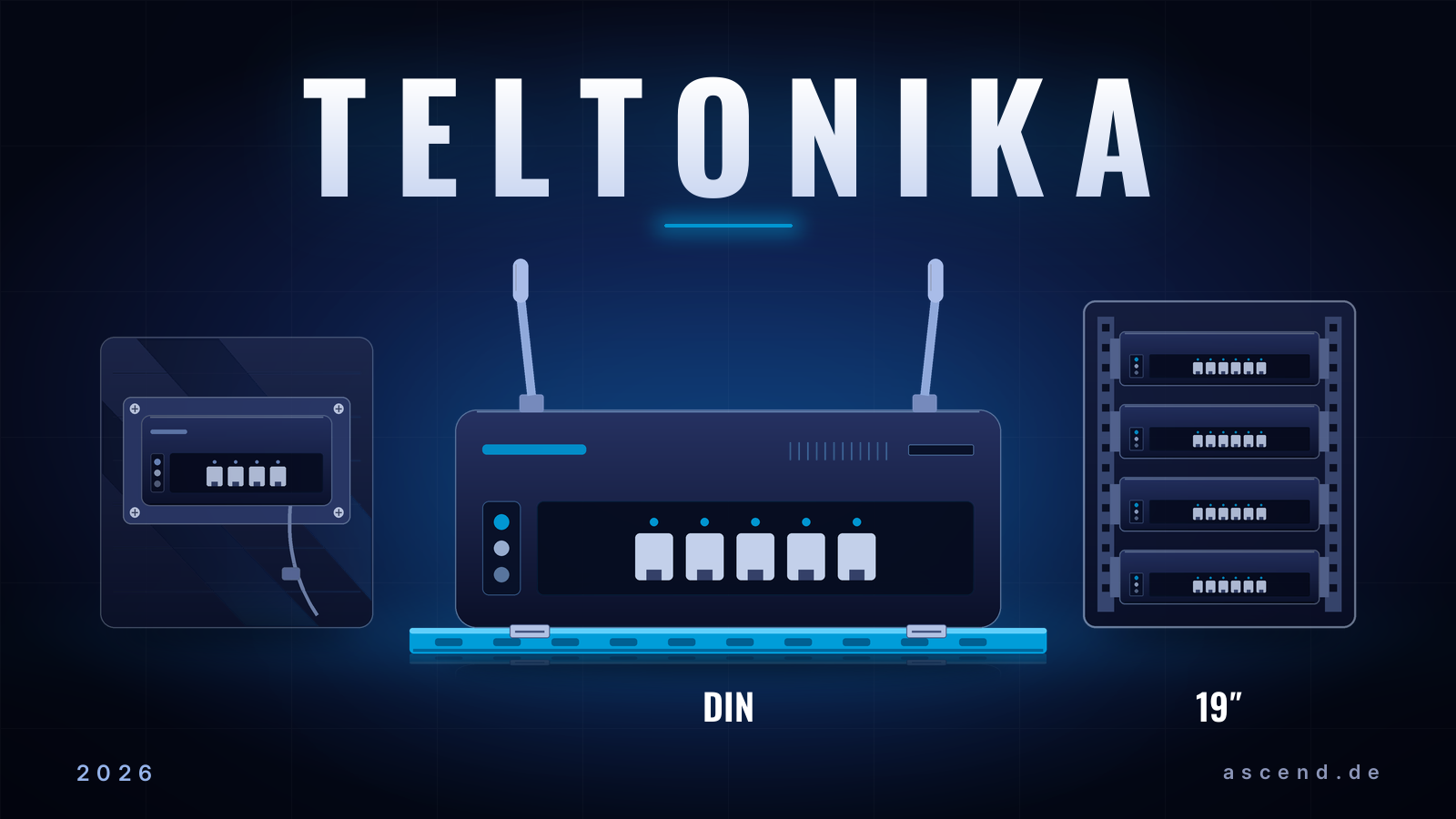
Mounting industrial routers: DIN rail, surface or rack — making the right choice
Mounting industrial routers: DIN rail, surface or rack? The three options for Teltonika devices compared — with benefits, deployment sites and a decision guide for control cabinet, wall and server room.
What Is RutOS? The Teltonika Operating System Clearly Explained
RutOS is the operating system of Teltonika’s routers and gateways. We explain device families, the Stable/Latest model, security maintenance and the feature set of version 7.24.
Teltonika TSF010: VDC-only Order Codes End on 1 October 2026 — What Buyers Need to Know
PCN of 7 August 2026: Teltonika discontinues the TSF010’s VDC-only order codes on 1 October 2026. What this means for procurement, BOMs and ongoing projects.