








Broadcasting case study
SD-WAN Outside Broadcast at MDR: No Dropouts
If one network falters at a packed stadium, the decisive jump still goes out live.
- Outside broadcast at a ski jump: the OB van is on air.
- The stands are full. The mobile cell is shared by everyone there.
- One network falters. With bonding, the others carry the picture on.
- The decisive jump goes out live, without a dropout.
The principle at a glance
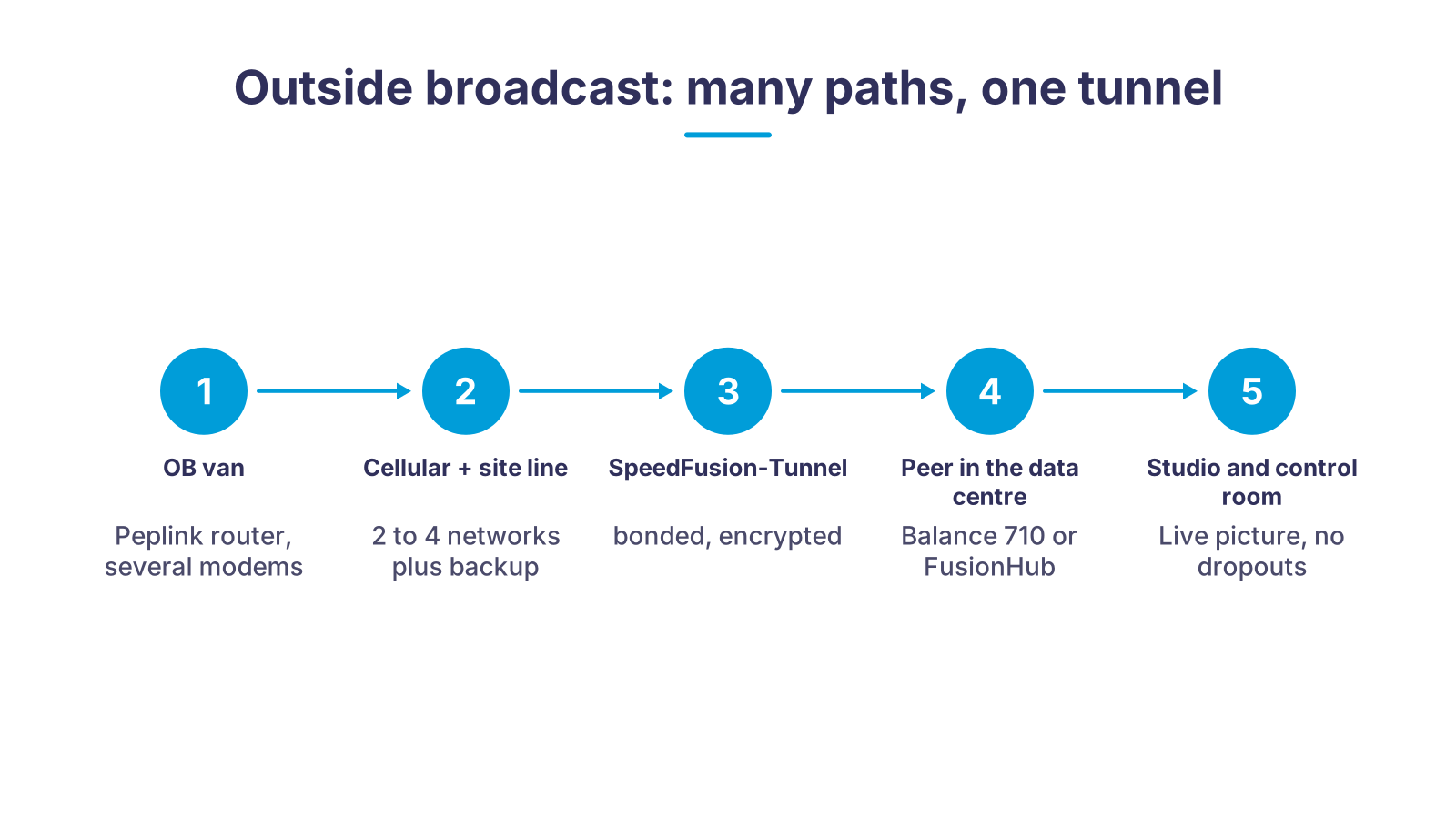
This is how a bonding solution for outside broadcasts is typically built: an OB van carries a Peplink router with several cellular modems. It bonds the mobile networks and an existing connection on site into one encrypted SpeedFusion tunnel that terminates at a far-end endpoint, right where the pictures need to go. If one path fails, traffic continues over the others. All routers are managed with InControl2; we explain that further below.
Which risks SD-WAN removes from outside broadcasting
Six risks every outside broadcast knows, and how a Peplink solution like MDR's addresses them.
The dropout at the decisive moment
One line, one risk
Dependence on the cable
Devices without an overview
Subsidiaries without a solution of their own
Operations that cost time
How the project ran at MDR
- 1Define the requirementMDR wanted to extend its existing transmission systems, not replace them: fail-safe, designed specifically for outside broadcasts, easy to adapt to users' needs, with a line backup for existing WAN connections.
- 2Consulting and selectionAfter individual consulting by Vitel and Ascend GmbH, MDR chose three Peplink routers: Balance 710, MAX HD4 LTE-A and MAX Transit Duo LTE-A.
- 3InControl2 on its own VMware serverInControl2 is added on top, Peplink's tool for device management, monitoring and reporting. InControl2 was installed on an existing MDR VMware server.
- 4Integrate bonding into the transmission chainThe bonded bandwidth was combined with the existing transmission systems, giving live recordings maximum resilience.
- 5Think of the whole corporate groupThe goal was a central bonding solution for the entire MDR corporate group. Subsidiaries are to operate and administer their own routers independently; InControl2 is multi-tenant for exactly that.
- 6Management and operationsAccording to MDR, the solutions are easy to manage via InControl2, and Peplink's managed service saves time and costs. Ascend's press release on the project was published on 6 May 2020.
Single line, failover or bonding: what happens when a link fails
| Single line | Hot failover | SpeedFusion bonding | |
|---|---|---|---|
| One path fails | The stream drops. | The router switches to the backup path. | Traffic continues over the other paths; according to Peplink, sessions stay active. |
| Available bandwidth | That of one connection. | That of the path currently active. | The sum of all paths, limited by the router's SpeedFusion throughput. |
| Fluctuating cell | Picture artifacts and buffering. | Switching only once the active path is detected as degraded. | SpeedFusion smooths traffic across several paths (smoothing according to the Peplink data sheet). |
| Typical use | Non-critical contributions. | Backup for an existing WAN connection. | Live outside broadcast, mobile control room, OB van. |
Starting point: live pictures do not wait
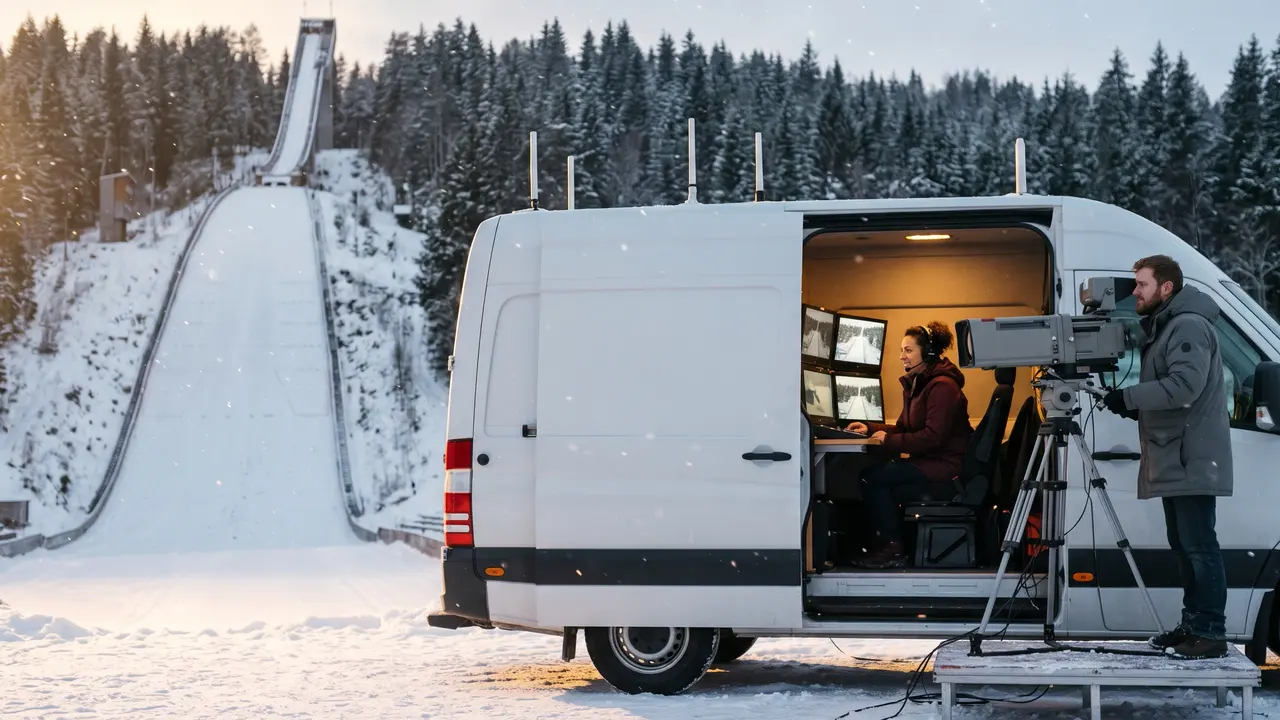

Mitteldeutscher Rundfunk produces a broad programme, and a large part of it is made outdoors: sports events, political events, concerts. For every one of these live broadcasts the same applies: connection problems are not an option. Even the shortest interruption is enough to miss the decisive scene, such as a ski jumper's winning jump. That costs viewer satisfaction and harms the broadcaster's image.
An example of how quickly this can happen: when the stadium is full, a mobile cell shares its capacity with every user on site, and it can collapse.
MDR therefore looked for an additional router solution that does three things at once. First, it had to be suitable for outside broadcasts and easy to adapt to the needs of the teams on site. Second, the existing WAN connections were to get a line backup. Third, the broadcaster wanted to be able to provide transmission capacity flexibly, independent of wired connections.
Added to that was a project goal that goes beyond the single OB van: a central bonding solution for the entire MDR corporate group, in which subsidiaries will in future operate and administer their own routers independently.
The solution: Peplink bonding and InControl2 on its own VMware server
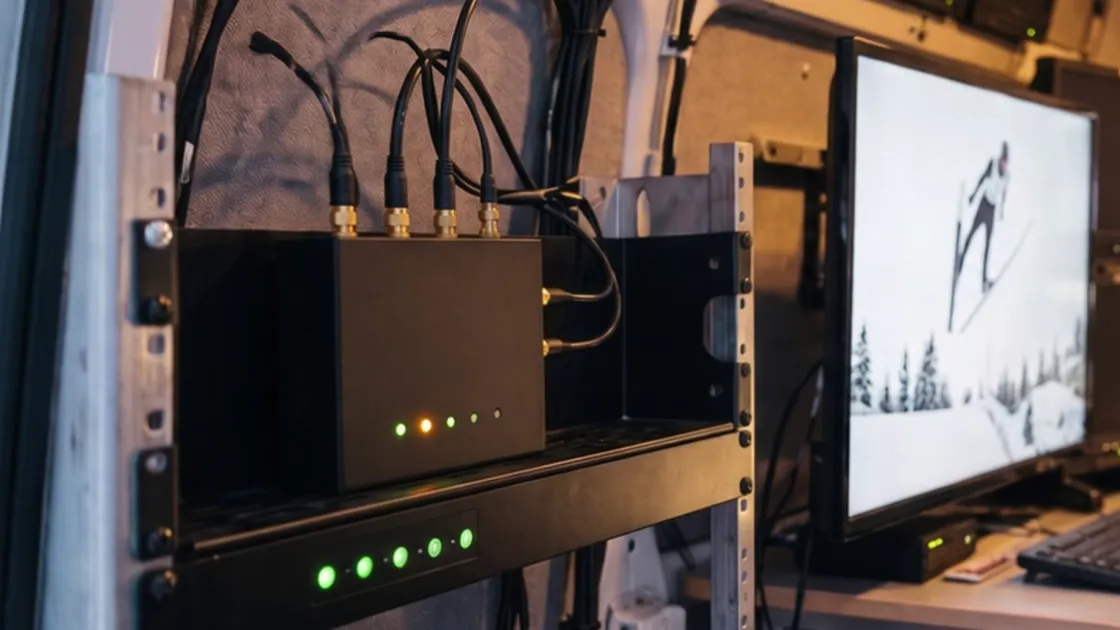
In the OB van, the router bonds several networks. If one of them falters, as at a full stadium, the traffic keeps running over the others.
According to Ascend's press release of 6 May 2020, after individual consulting by Vitel and Ascend GmbH, MDR chose three Peplink routers: Balance 710, MAX HD4 LTE-A and MAX Transit Duo LTE-A. This allows the broadcaster to bond all available bandwidth and ensure reliable data transmission. The bonded bandwidth works together with the existing transmission systems.
The second building block is InControl2, Peplink's tool for device management, monitoring and reporting. InControl2 was installed on an existing MDR VMware server. The platform is multi-tenant, which fits the project goal: subsidiaries are to operate and administer their own routers independently.
What such a setup typically looks like: a bonding tunnel has two ends, the mobile router in the vehicle and a far-end endpoint where the partial streams are reassembled. This role is played by a stationary router of the Balance series or a virtual FusionHub, which according to Peplink runs on VMware, among others.
The device families from the MDR project are available today in current models: the MAX HD4 MBX 5G with four 5G modems and the MAX Transit Duo Pro with two CAT-12 modems, both with redundant SIM slots, SpeedFusion bonding and InControl2 management (according to the Peplink data sheet).
What Ascend delivers for broadcasters and production companies
Ascend has been an IT systems house in Nuremberg since 2010 and is a Peplink partner. For broadcasters, broadcast-technology service providers and production companies we deliver the complete chain from a single source:
- Planning and consulting: We plan WAN and cellular access including bonding and advise you expertly on hardware and software: which networks are available at the location, which router fits, where does the far-end endpoint sit?
- Hardware and data plans: Peplink routers from the Ascend Shop, plus data plans matched to the available carriers.
- Far-end endpoint: We set up and operate a hosted far-end endpoint in your data centre.
- Rental: For single productions or a season we rent out SD-WAN hardware, such as the MAX HD4 MBX 5G.
- Support 24×7: Our support is reachable for existing customers around the clock.
The approach from the MDR project applies in general: bonding complements the existing transmission chain instead of replacing it.
Bonding needs a far-end endpoint
A SpeedFusion tunnel has two ends. The router in the OB van bonds, but only the far-end endpoint reassembles the partial streams. This can be a stationary router of the Balance series or the virtual FusionHub: according to Peplink it runs on VMware, Hyper-V, Citrix XenServer, VirtualBox or AWS, needs at minimum an Intel Core i5, 4 GB RAM and 100 GB of disk, and can be tested free for 30 days. On request, Ascend sets up and operates the far-end endpoint in your data centre.
Suitable hardware in the Ascend Shop
Current models of the device families from the MDR project, plus far-end endpoint, management and rental device. Prices and delivery times are in the shop (as of 7 November 2026).
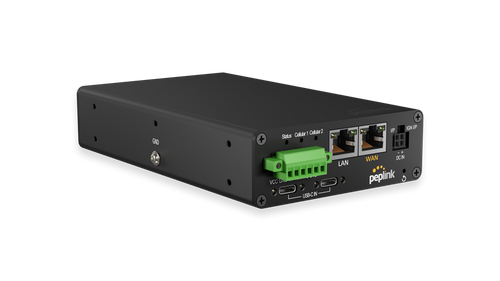
Peplink MAX Transit Duo Pro
Current model of the MAX Transit family from which MDR chose the MAX Transit Duo LTE-A in 2020: two CAT-12 modems with redundant SIM slots, Wi-Fi 6, 1 Gbit/s router throughput, SpeedFusion bonding up to 400 Mbit/s (according to the Peplink data sheet), 12 to 56 V DC with ignition sensing.
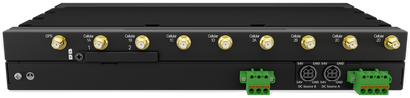
Peplink MAX HD2 MBX 5G
The dual-modem tier of the MBX platform with 5G. For OB vans that want to bond two networks without running four modems straight away. Delivery time on request.
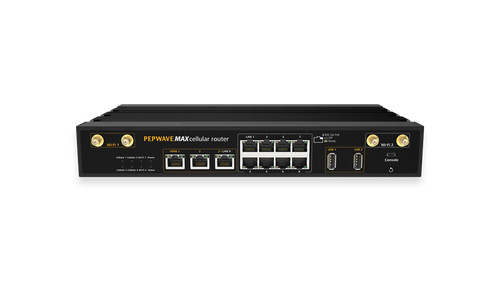
Peplink MAX HD4 MBX 5G
Current model of the MAX HD4 family from which MDR chose the MAX HD4 LTE-A in 2020: four 5G modems with redundant SIM slots, up to 16 mobile carriers via SIM Injector, 2.5 Gbit/s router throughput, SpeedFusion encrypted 500 Mbit/s, 8 PoE ports for cameras and access points (according to the Peplink data sheet).

Peplink FusionHub Pro
The virtual SpeedFusion far-end endpoint for your data centre or cloud: runs on VMware, Hyper-V, XenServer, VirtualBox or AWS and terminates the OB van routers' tunnels right where the pictures need to go.
Peplink InControl 2 Subscription (1 year)
Central management of all Peplink devices: configuration profiles, firmware rollouts, GPS fleet tracking, WAN quality reports and remote access to every device. Available immediately.
Peplink MAX HD4 MBX 5G as a rental device
For a single production or the season: rent the router with four 5G modems instead of buying it.
The decisive scene goes out live

Sports, concerts, political events: when Mitteldeutscher Rundfunk broadcasts live from outdoors, the link must not drop. That is why MDR is extending its transmission systems with Peplink routers that bond all available bandwidth, managed with InControl2 on its own VMware server. Vitel and Ascend provided the consulting, and Ascend delivered the solution.
The scenes on this page are re-staged. They show neither MDR staff nor any specific event.
What MDR says
In the end, the Peplink solutions convinced us with their good value for money and intuitive operation. The versatile product range, above all the central management platform InControl2, and the flexibility of network routing matched our expectations exactly.
Integrating the Peplink devices and the bonded bandwidth, in combination with the existing transmission systems, gives us maximum resilience when transmitting live recordings. Through the multi-tenant management platform InControl2 we can manage the solutions easily, and with Peplink's managed service we also save time and costs.
Frequently asked questions about SD-WAN in outside broadcasting
Further links
Ready for outside broadcasts without dropouts?
Tell us what you are broadcasting, from where, and which connections are available on site. We will propose the right combination of Peplink router, SIM cards and far-end endpoint, matched to your existing transmission chain, as at MDR.
We look forward to hearing from you!
Tell us the location, the type of broadcast and the connections available. We will get back to you shortly with a personal assessment.