








Teltonika Bonding: several lines, one connection
Use every line at once, with no drop-out when one of them fails.

What is Teltonika bonding?
Teltonika bonding means that a Teltonika router uses several internet lines at the same time and combines them into a single, resilient connection. The bonding itself is done by the S.A.NE software (Simple Aggregation of Networks) from Bondix Intelligence. It runs as a package on the router, splits the data stream into packets and sends them over all available lines at once, for example mobile, DSL, cable and Starlink. A Bondix server in the data centre puts the packets back together and passes them on as one connection.
The result: more bandwidth than the best single line, and no dropped session when a line fails. Video calls, live streams, VPN or point-of-sale systems simply keep running. Ascend offers this in partnership with Bondix Intelligence as a ready-configured solution: router, licence, hub and, on request, the SIM cards.
The principle at a glance
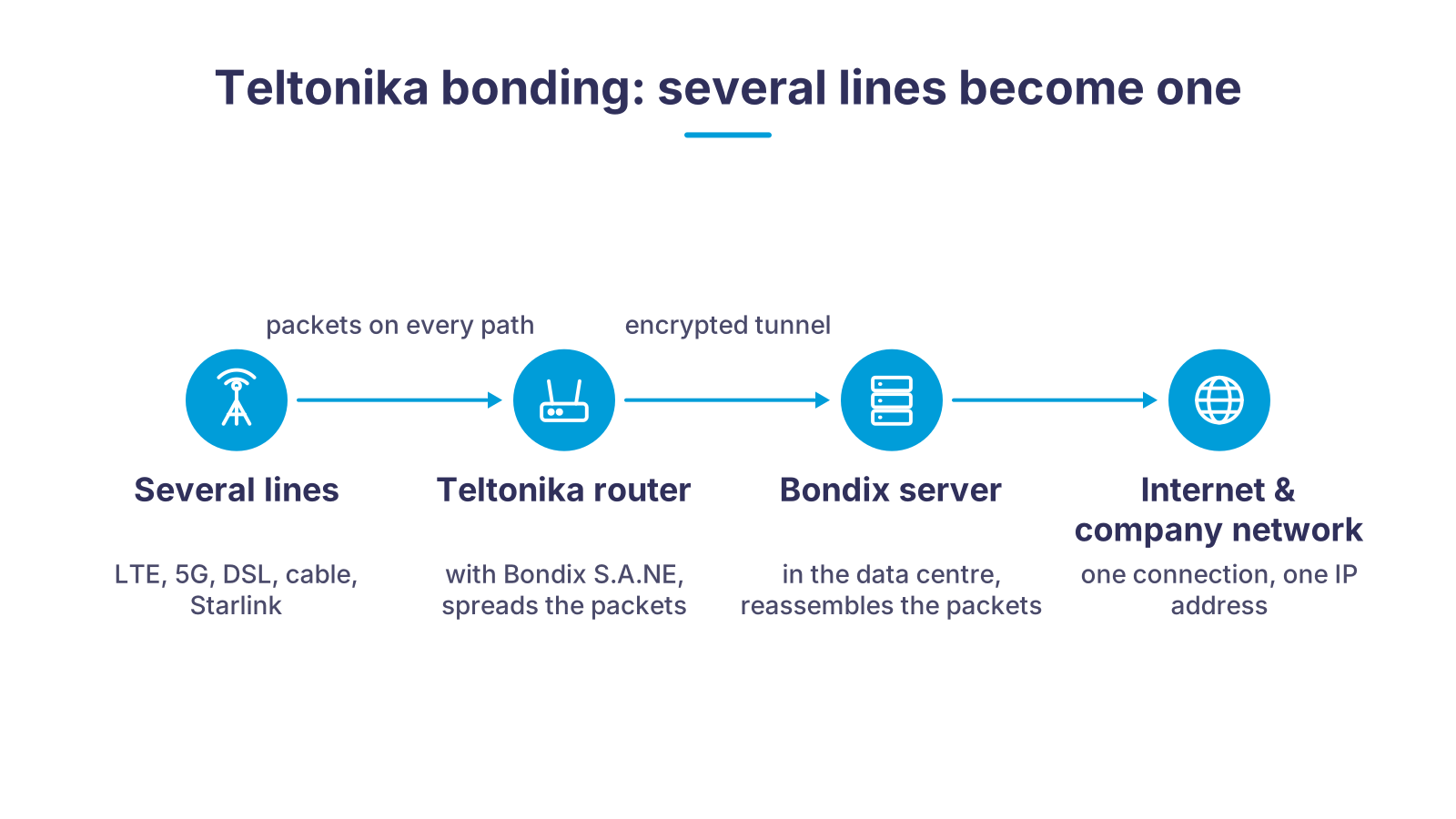
On the left, the lines available at the site or in the vehicle. In the middle, the Teltonika router with the Bondix package: it spreads every data stream packet by packet across all active lines. On the right, the Bondix server in the data centre, which puts the packets back together in the right order. To your applications it looks like a single connection that no single line can unplug any more.
What Teltonika can do on its own and what Bondix adds
Without additional software, Teltonika routers running RutOS offer Multi-WAN in two modes. Failover switches to a backup line when the main line fails. Load balancing distributes connections across several lines by weight. Both increase availability, but according to Teltonika load balancing does not speed up any single connection: a download or a video call stays on one line, and after switching the session is rebuilt. The two modes cannot be used at the same time.
True bonding is not a built-in RutOS feature. For that, S.A.NE from Bondix Intelligence is installed on the router as a package. Teltonika's documentation states explicitly that this package comes from a third party and that Teltonika is not responsible for its compatibility, security or stability; the package is Bondix's responsibility. Router, licence and server therefore have to match. That is exactly the combination we put together.
Failover, load balancing or bonding?
| Failover (RutOS) | Load balancing (RutOS) | Bonding (Bondix S.A.NE) | |
|---|---|---|---|
| Lines in use | One active, the others wait | Several, each connection on one | All at once, packet by packet |
| Speed of a single transfer | That of the active line | That of one line | More than the best single line, limited by overhead and licence tier |
| When a line fails | Switch-over, running connections drop | Affected connections are rebuilt | The session stays up, traffic runs over the remaining lines |
| Counterpart needed | No | No | Yes, a Bondix server, self-hosted or hosted |
| Fixed public IP | Only via the line's tariff | Only via the lines' tariffs | On your own hub, independent of the lines |
| Additional cost | None | None | Bondix licence plus server or hosted hub |
How Bondix S.A.NE works
S.A.NE has three modes that can be chosen per application:
- Seamless backup: several lines are ready, the primary one is used. If it fails, the system switches to the next without dropping existing connections. Unlike RutOS failover, the session is kept.
- Load balancing with seamless handover: data is spread across the available lines; if one fails, its traffic moves to another without interruption.
- Bonding (WAN aggregation): one application uses the bandwidth of all lines at once. This helps when no single line is fast enough, for example for a live stream from an area with poor coverage.
On top come functions such as packet duplication for particularly sensitive applications and latency smoothing. The counterpart is the Bondix server, a virtual appliance (OVA) that runs on your own server or in the cloud. Every Bondix licence includes the server image for self-hosting and is bound to active tunnels, not devices. If you do not want to run your own server, use our hosted Bondix hub in Germany.
Which Teltonika routers support Bondix
According to Teltonika, the Bondix package runs on the RUTX series, the RUTM series and on the RUT901, RUT906, RUT951, RUT956, RUT200, RUT241, RUT260, RUT206, RUT271 and RUTC50. Which model fits depends on which lines you want to bond:
- One mobile network plus fixed line or Starlink: a router with one modem is enough, such as the compact RUT241 or the RUTX11. Important: a modem only ever uses one SIM card at a time; the second SIM is a reserve, not a second line.
- Two mobile networks at the same time: this needs two modems in one device, for example the RUTX12 with two LTE Cat 6 modems or the RUTM52 with two 5G modems.
Bondix licences are tiered by bandwidth: IoT 20 Mbps, Standard 100 Mbps, Enterprise 200 Mbps and Ultimate 500 Mbps. According to Bondix (as of February 2026), the larger Velocity and Stratos tiers are not suitable for Teltonika routers. We recommend the tier based on the lines that actually arrive on site, not on the peak rate in the data sheet.
How your Teltonika bonding goes live
- 1Clarify requirementsWhat should run over the connection: live stream, video calls, tills, cameras, VPN? This determines bandwidth, licence tier and whether a fixed IP is needed.
- 2Check the lines on siteWhich mobile networks are good at the site, is there DSL or cable, does Starlink make sense? We recommend the combination, not the most expensive single line.
- 3Choose router and licenceOne or two modems, LTE or 5G, and the matching Bondix licence. You can order routers and licences directly in the Ascend Shop.
- 4PreconfigureWe install the Bondix package, set up the lines and the tunnel and test everything before shipping. On site it is: plug in, done.
- 5Operate the hubThe tunnel ends on the Bondix hub in a data centre in Germany or on your own server. Existing customers get 24×7 support.
What Ascend takes care of
Ascend has been an IT systems house in Nuremberg since 2010 and puts Teltonika bonding together from a single source: Teltonika router, Bondix licence, counterpart and, on request, the matching SIM cards with a data plan. For the counterpart there are two options. The Bondix shared hub costs €29 per active tunnel per month, with unlimited data under fair use, but without inbound connections. A dedicated hub comes with a static IPv4 address and port forwarding, so that cameras or servers on site can be reached from outside. Details and prices are on our VPN hub hosting page. For short deployments such as trade fairs or events, the Bondix Hosted Essential Pass is available in the shop.
If you would rather bond with Peplink and SpeedFusion or need a fixed connection for a whole site, read on at virtual leased line. An overview of mobile routers with a SIM card is on the mobile router page, and all Teltonika models are in our Teltonika overview.
Bonding always needs a counterpart
A router on its own can only switch lines or distribute connections. It can only bond once a server at the other end puts the packets back together. So plan the Bondix server in from the start, as a hosted hub or on your own server with a good connection. And: bonding adds bandwidth but does not lower the base latency. If lines with very different delays are bonded, such as Starlink and DSL, we deliberately tune the settings for telephony and video.
Matching hardware and licences in the Ascend Shop
Teltonika routers with Bondix support, the licence and the counterpart. Prices and availability are shown on each shop page.
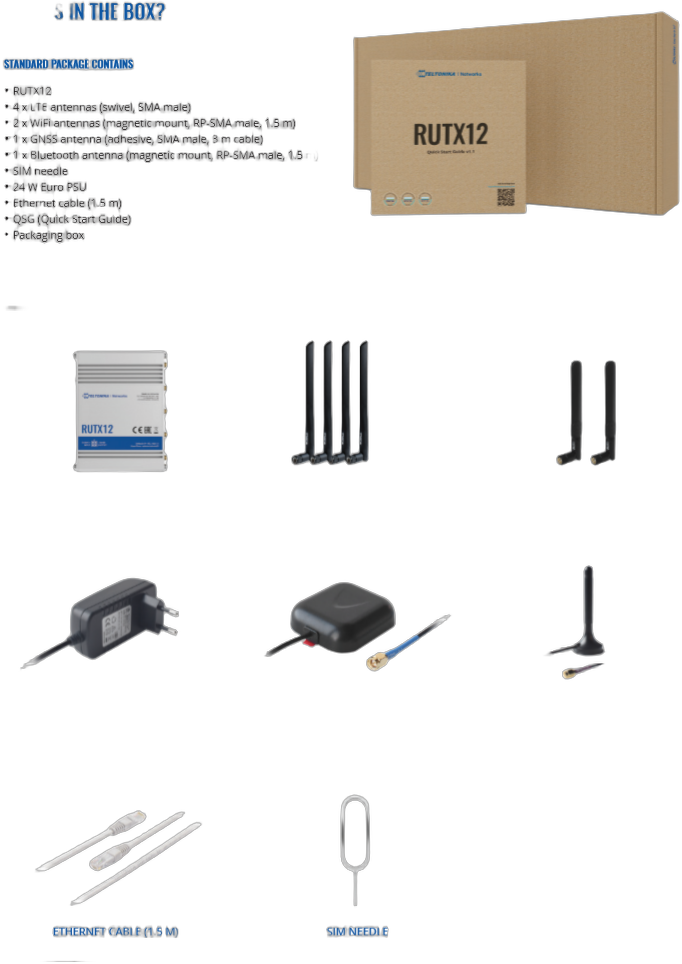
Teltonika RUTX12
Two LTE Cat 6 modems in one device: bond two mobile networks at the same time, with dual-band Wi-Fi.
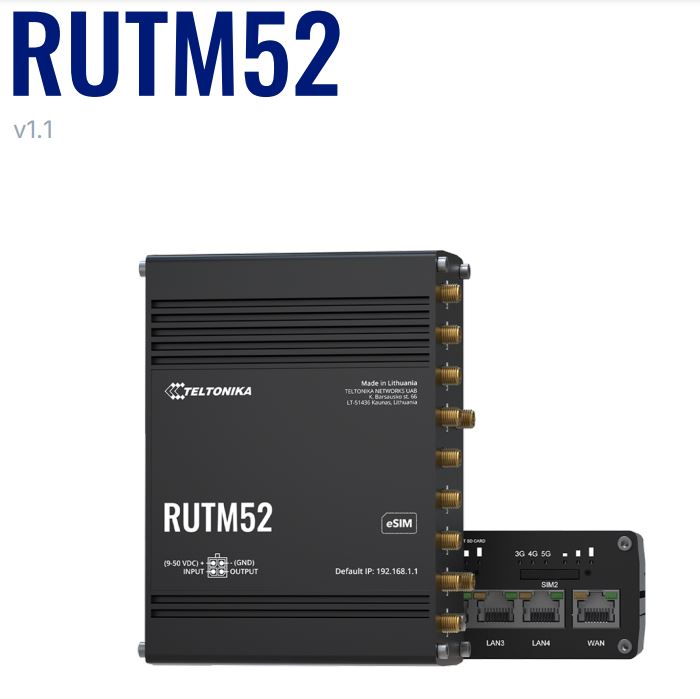
Teltonika RUTM52
Dual 5G router with two 5G modems for sites where two 5G networks should carry traffic at once.
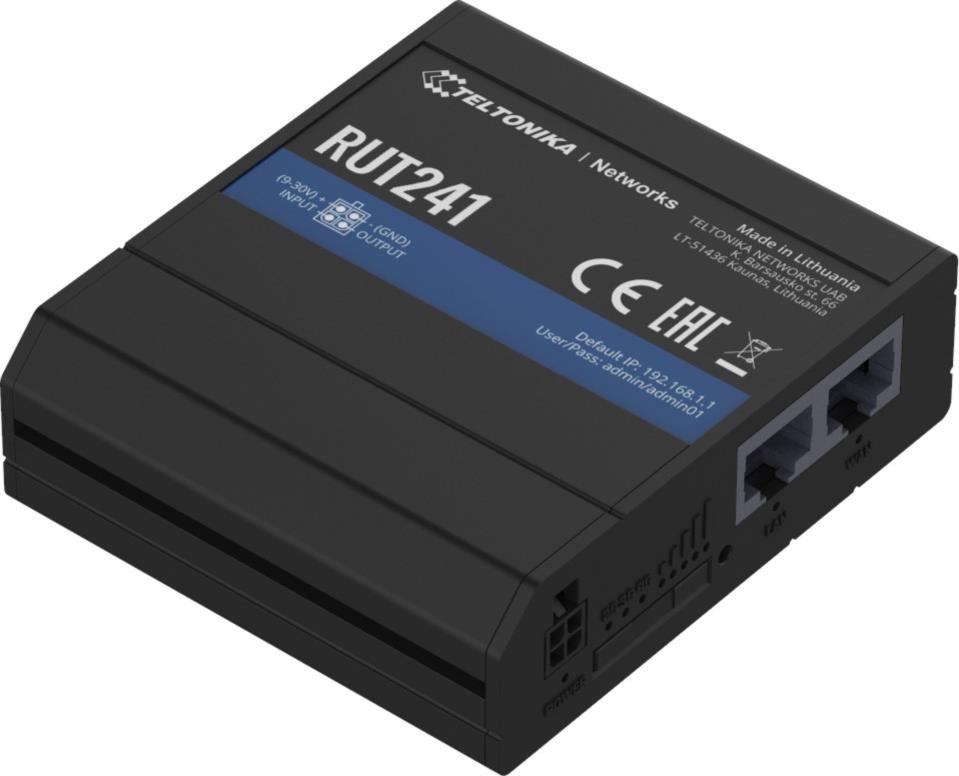
Teltonika RUT241
Compact LTE router for getting started: bond mobile with a fixed line or Starlink.
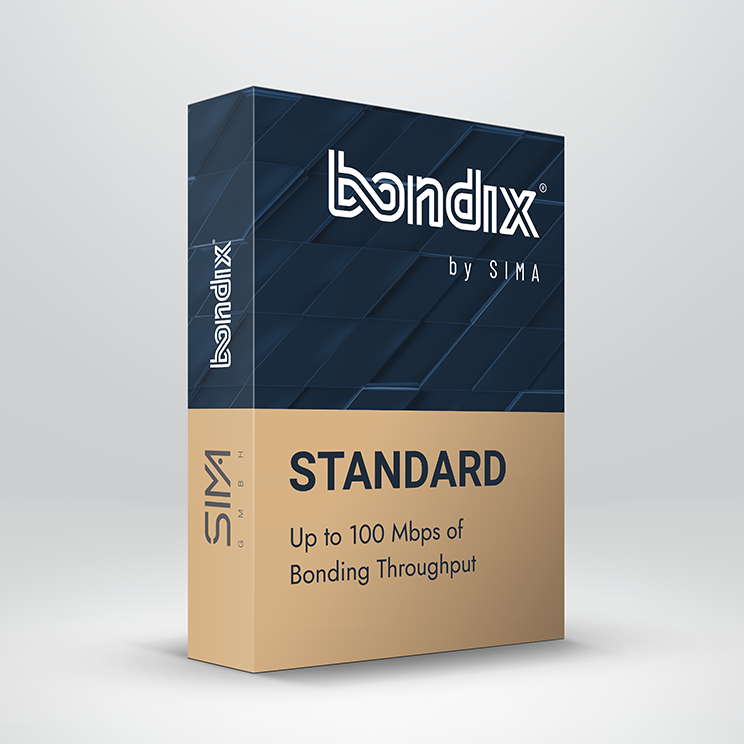
Bondix Standard licence, 100 Mbps
Bonding licence for 12 months, bound to the active tunnel, server image for self-hosting included.
- Bondix Bonding Hub shared hub
Bondix Bonding Hub shared hub
S.A.NE counterpart for Teltonika routers in a German data centre, €29 per active tunnel per month, unlimited data (fair use).
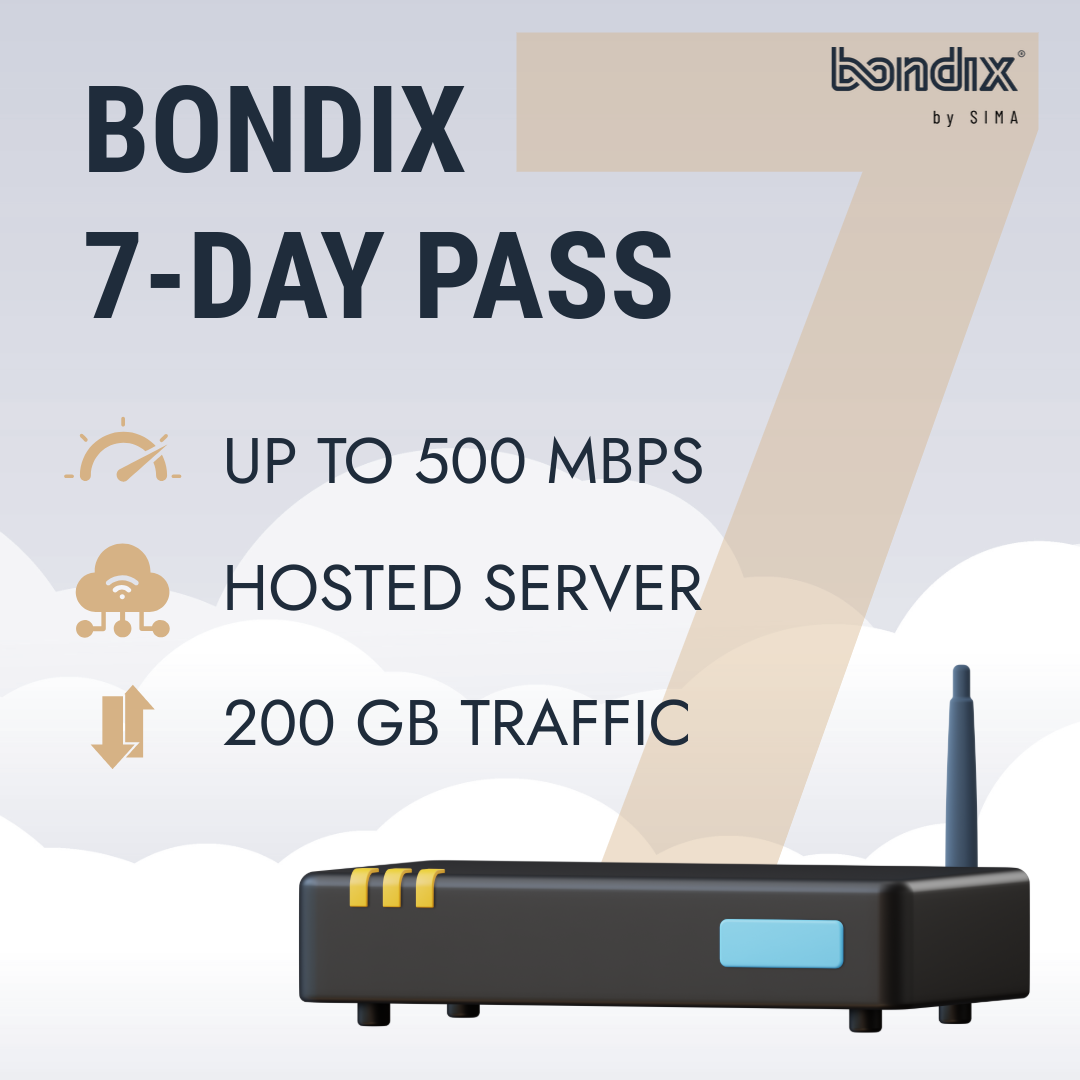
Bondix Hosted Essential 7-day pass
Hosted Bondix server in Germany including licence for short deployments, ready to use immediately.
Frequently asked questions about Teltonika bonding
Further links
Ready to bond your lines?
Tell us which lines are available at the site or in the vehicle and what should run over them. We will recommend router, licence and hub and give you the price.
We look forward to hearing from you!
Send us a message — we will get back to you shortly with personal advice.